
2026-02-09 ゲーテ大学
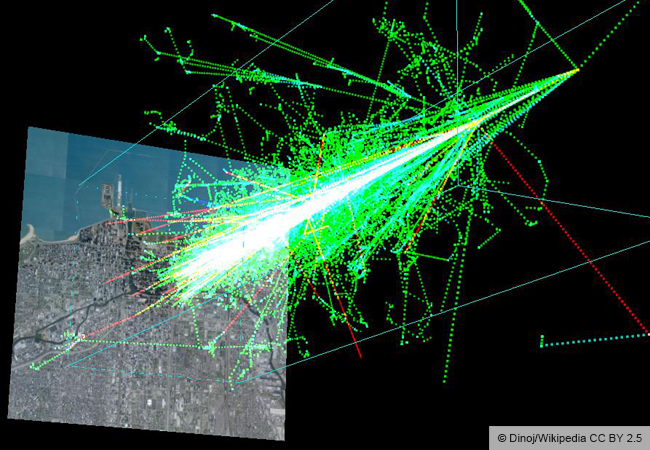
Cosmic ray air shower created by a 1 TeV proton hitting the atmosphere 20 km above the Earth. The shower was simulated using the AIRES package.
<関連情報>
- https://aktuelles.uni-frankfurt.de/english/bridge-between-particle-accelerators-and-cosmic-radiation-physicists-develop-a-new-approach-for-simulations/
- https://www.nature.com/articles/s42254-025-00897-3
- https://www.nature.com/articles/s42254-025-00897-3.epdf
加速器ベースおよび宇宙粒子データを用いたハドロン相互作用モデルのグローバルチューニング Global tuning of hadronic interaction models with accelerator-based and astroparticle data
J. Albrecht,J. Becker Tjus,N. Behling,J. Blazek,M. Bleicher,J. Boelhauve,L. Cazon,R. Conceição,H. Dembinski,L. Dietrich,J. Ebr,J. Ellbracht,R. Engel,A. Fedynitch,M. Fieg,M. V. Garzelli,C. Gaudu,G. Graziani,P. Gutjahr,A. Haungs,T. Huege,K. Hymon,M. Hünnefeld,K.-H. Kampert,… V. Zhukov
Nature Reviews Physics Published:16 December 2025
DOI:https://doi.org/10.1038/s42254-025-00897-3
Abstract
In high-energy and astroparticle physics, event generators have an essential role, even in the simplest data analyses. Physical processes occurring in hadronic collisions are simulated within a Monte Carlo framework but a major challenge remains modelling of hadron dynamics at low momentum transfer, which includes the initial and final phases of every hadronic collision. Phenomenological models inspired by quantum chromodynamics used for these phases cannot guarantee completeness or correctness over the full phase space. These models usually include parameters which must be tuned to suitable experimental data. Until now, event generators have primarily been developed and tuned based on data from high-energy physics experiments at accelerators. However, in many cases, they have been found to not satisfactorily describe data from astroparticle experiments, which provide sensitivity especially to hadrons produced nearly parallel to the collision axis and cover centre-of-mass energies up to several hundred tera-electronvolts, well beyond those reached at colliders so far. Here, we address the complementarity of these two sets of data and present a roadmap for a unified tuning of event generators with accelerator-based and astroparticle data.

