2026-01-16 北海道大学 触媒科学研究所
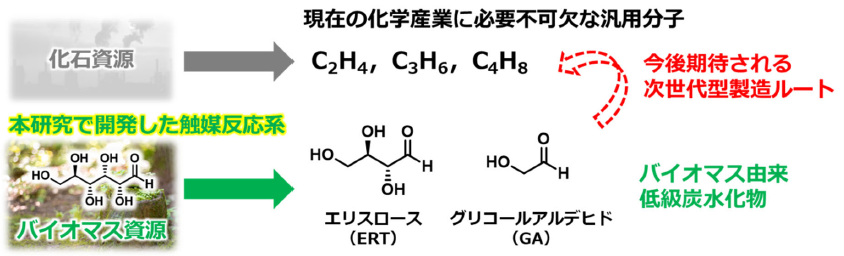
グルコースを出発原料とした低級炭水化物の合成
<関連情報>
- https://www.hokudai.ac.jp/news/2026/01/post-2165.html
- https://www.hokudai.ac.jp/news/pdf/260116_pr.pdf
- https://pubs.acs.org/doi/10.1021/acscatal.5c08041
触媒的その場アセタール化戦略によるグルコースからのC4・C2炭水化物誘導体の高収率合成 Catalytic In Situ Acetalization Strategy for High-Yield Synthesis of C4– and C2-Carbohydrate Derivatives from Glucose
Ryota Osuga,Navya Subray Bhat,Quan Shi,Natsumi Shibayama,Mizuho Yabushita,Satoshi Suganuma,Hiroki Taniguchi,Mizuki Tada,Hideki Kato,Long Zhang,Ivo Filot,Emiel J. M. Hensen,and Kiyotaka Nakajima
ACS Catalysis Published: December 19, 2025
DOI:https://doi.org/10.1021/acscatal.5c08041
Abstract
The development of heterogeneous catalytic upgrading processes for glucose, the most abundant carbohydrate in plant biomass, is crucial for advancing the production of renewable chemicals. Among the promising strategies, retro-aldolization enables direct and selective cleavage of C–C bonds, offering a route to valuable C4 and C2 carbohydrates: erythrose (ERT) and glycolaldehyde (GA). These compounds serve as key precursors to a range of high-value chemicals. However, their susceptibility to degradation by humin formation hinders practical implementation. Here, we present a catalytic strategy involving Nb2O5 and H-MOR zeolite for converting glucose in ethanol to ERT and GA through selective retro-aldolization (Nb2O5), followed by in situ acetalization to form the corresponding stable acetals of ERT and GA (H-MOR). Lewis acidic Nb5+ in NbO4 tetrahedra in the Nb2O5 surface catalyzes retro-aldolization of glucose, while Bro̷nsted acid sites in the H-MOR pores provide a shape-selective reaction environment for the acetalization of ERT and GA with ethanol. The exclusion of glucose from the one-dimensional micropores of H-MOR is critical to the high efficiency achieved. This method for glucose conversion in heterogeneous catalysis, based on protection principles common in synthetic organic chemistry, can impact the use of glucose as a feedstock for making renewable C4 and C2 chemicals.