2026-01-12 ハーバード大学
<関連情報>
- https://salatainstitute.harvard.edu/anyone-can-audit-methane-with-this-harvard-tool/
- https://www.nature.com/articles/s41467-025-67122-8
衛星観測とUNFCCCの事前推定値の逆算による世界全体の国家メタン排出量の推定 Worldwide inference of national methane emissions by inversion of satellite observations with UNFCCC prior estimates
James D. East,Daniel J. Jacob,Dylan Jervis,Nicholas Balasus,Lucas A. Estrada,Sarah E. Hancock,Melissa P. Sulprizio,John Thomas,Xiaolin Wang,Zichong Chen,Daniel J. Varon & John R. Worden
Nature Communications Published:11 December 2025
DOI:https://doi.org/10.1038/s41467-025-67122-8
Abstract
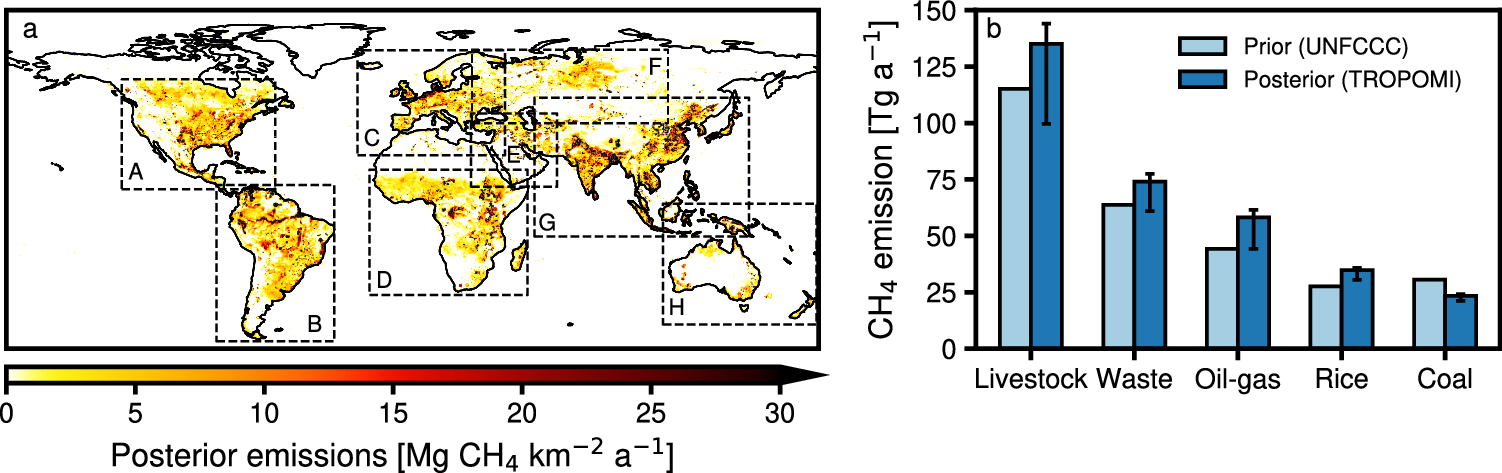
Meeting climate policy goals to reduce methane emissions under the Paris Agreement and the Global Methane Pledge requires nations to set targets and quantify reductions. Individual countries report emissions by sector to the United Nations Framework Convention on Climate Change (UNFCCC) but there are large uncertainties. Here we optimize 2023 national emissions at up to 25 km grid resolution for 161 countries with a globally consistent open-source framework for inverse analysis of Tropospheric Monitoring Instrument (TROPOMI) satellite observations, using UNFCCC reports for prior estimates together with point source information from GHGSat and other satellites. We find global anthropogenic emissions to be 15% higher than UNFCCC reporting (32% for oil-gas), with national emissions more than 50% higher than reporting for a quarter of the countries. Oil-gas emission intensities vary by two orders of magnitude between countries. Sub-Saharan Africa has the highest livestock emission intensity of any region. Hydroelectric reservoirs, generally not included in UNFCCC reporting, contribute 6% of anthropogenic emissions globally. The framework allows updates for subsequent years, enabling monitoring of emission trends and support for improved reporting.