2025-09-26 京都大学
Web要約 の発言:
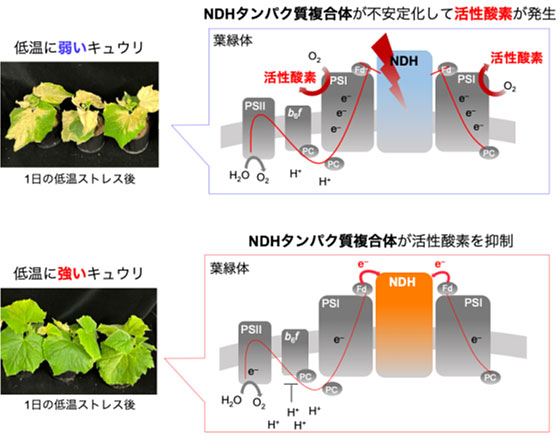
研究成果の概要図:低温に弱いキュウリ品種は、低温ストレス時に葉緑体NDHタンパク質複合体が分解・不安定化して活性酸素が発生する(上)。低温に強いキュウリ品種では、NDHは正常に機能する(下)。
<関連情報>
- https://www.kyoto-u.ac.jp/ja/research-news/2025-09-26
- https://www.kyoto-u.ac.jp/sites/default/files/2025-09/web_2509_Ifuku-78424927874b815a581ed8d61ae64876.pdf
- https://nph.onlinelibrary.wiley.com/doi/10.1111/nph.70573
低温ストレス下におけるPSI光阻害に対する葉緑体NADH脱水素酵素様複合体(NDH)の保護的役割 The protective role of chloroplast NADH dehydrogenase-like complex (NDH) against PSI photoinhibition under chilling stress
Ko Takeuchi, Shintaro Harimoto, Yufen Che, Minoru Kumazawa, Hayato Satoh, Shu Maekawa, Chikahiro Miyake, Kentaro Ifuku
New Phytologist Published: 18 September 2025
DOI:https://doi.org/10.1111/nph.70573
Summary
- Chilling stress induces photosystem I (PSI) photoinhibition in various plants, severely impairing their growth. However, the mechanisms suppressing chilling-induced PSI photoinhibition remain unclear.
- To identify factors preventing PSI photoinhibition, we compared two cucumber cultivars with different susceptibilities to PSI photoinhibition and chilling stress tolerance.
- Chilling stress caused uncoupling of thylakoid membrane in both cultivars, as previously reported. However, in the chilling-sensitive cultivar, electron efflux from ferredoxin (Fd) was more restricted under chilling stress, resulting in over-reduction of PSI. This over-reduction was observed not only under chilling stress but also under limited CO2 condition, suggesting that the lower alternative electron flow activity contributes to the cultivar difference in PSI photoinhibition. Indeed, the chilling-sensitive cultivar lost the activity of the chloroplast NADH dehydrogenase-like complex (NDH) due to destabilization of the PSI–NDH supercomplex under chilling stress, resulting in severe Fd over-reduction. By contrast, the chilling-tolerant cultivar maintained NDH activity and suppressed reactive oxygen species and PSI photoinhibition during chilling stress.
- This study provides evidence that NDH functions as a crucial electron sink to prevent PSI photoinhibition and provides new insights into the mechanisms underlying low-temperature stress tolerance.