2025-09-08 カリフォルニア大学リバーサイド校 (UCR)
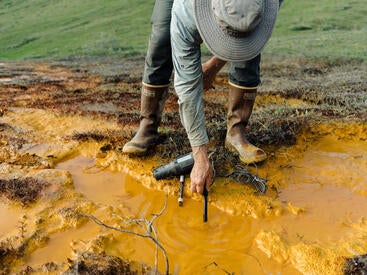
Researcher testing murky waters in Alaska’s Brooks Range. (Photo: Taylor Rhoades)
<関連情報>
- https://news.ucr.edu/articles/2025/09/08/orange-rivers-signal-toxic-shift-arctic-wilderness
- https://www.pnas.org/doi/10.1073/pnas.2425644122
荒々しく、風光明媚で、そして有害:永久凍土融解に伴う象徴的な北極圏水系の最近の劣化 Wild, scenic, and toxic: Recent degradation of an iconic Arctic watershed with permafrost thaw
Patrick F. Sullivan, Roman J. Dial, David J. Cooper, +4 , and Timothy W. Lyons
Proceedings of the National Academy of Sciences Published:September 8, 2025
DOI:https://doi.org/10.1073/pnas.2425644122
Significance
The Salmon River is among the most remote and protected watersheds in North America. Its pristine wilderness was featured in the opening chapter of John McPhee’s nonfiction classic, “Coming into the Country”. In 2019, the gin-clear waters of the Salmon turned orange and have remained turbid and discolored since. The sudden degradation of the Salmon and many other formerly clear streams in the region is thought to reflect sulfide mineral weathering following permafrost thaw. Here, we show the Salmon River mainstem and most of its tributaries have metal concentrations deemed toxic to aquatic life. Our findings might help explain a recent crash in chum salmon returns, which are an important commercial and subsistence resource in an economically challenged region.
Abstract
The streams of Alaska’s Brooks Range lie within a vast (~14M ha) tract of protected wilderness and have long supported both resident and anadromous fish. However, dozens of historically clear streams have recently turned orange and turbid. Thawing permafrost is thought to have exposed sulfide minerals to weathering, delivering iron and other potentially toxic metals to aquatic ecosystems. Here, we report stream water metal concentrations throughout the federally designated Wild and Scenic Salmon River watershed and compare them with United States Environmental Protection Agency (EPA) chronic (4-d) exposure thresholds for toxicity to aquatic life. The main stem of the Salmon had elevated SO42− concentrations and elevated SO42−: Ca relative to a predisturbance baseline for most of its length, consistent with increased sulfide mineral weathering. Most of the tributaries also had elevated SO42− concentrations and elevated SO42−: Ca, especially those in the upper watershed. The Salmon River mainstem consistently exceeded EPA chronic exposure thresholds for total recoverable iron, total recoverable aluminum, and dissolved cadmium from its first major tributary to its mouth. Nine of ten major tributaries that we sampled exceeded EPA thresholds for at least one metal on at least one of three sampling dates. Our findings indicate that habitat quality for resident and anadromous fish has been severely degraded in the Salmon River watershed. Loss of important spawning habitat in the Salmon and many other streams in the region might help explain a recent crash in chum salmon returns, which local communities depend upon for commercial and subsistence harvest.