2025-08-02 中国科学院(CAS)
中国科学院華南植物園の研究チームは、南シナ海の熱帯サンゴ島で、人間活動が塩性湿地(saltmarsh)の一次遷移を開始・加速する鍵となることを発見した。2023年、埋立地でほぼ自然状態の塩性湿地生態系を確認し、自然の回復力と人為的支援を組み合わせた「エコ修復戦略」の有効性を示した。埋立後1年以内に先駆植物トリダックス・プロカンベンスが定着し、海・鳥・風による種子散布で草本から低木への植生遷移が進行。比較研究の結果、埋立や種子散布が一次遷移の開始を促し、防波堤建設や耐性低木の導入が低木優占への移行を加速することが判明した。本成果は、熱帯サンゴ島塩性湿地の修復・管理戦略策定に有用な知見を提供する。
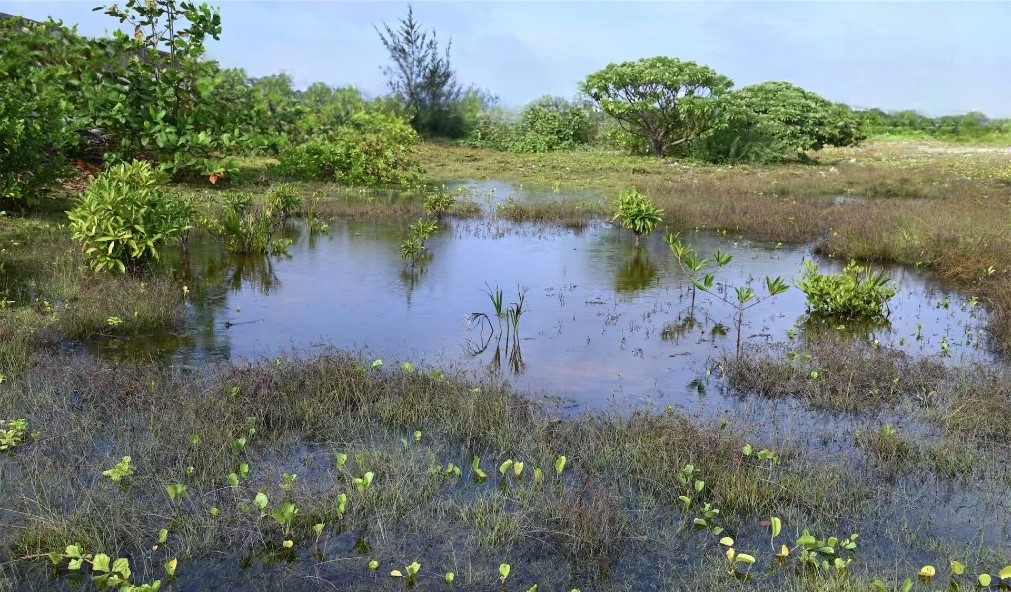
A near-natural saltmarsh ecosystem on a tropical coral island. (Imaged by YIN Deyi et al)
<関連情報>
- https://english.cas.cn/newsroom/research_news/life/202508/t20250811_1049955.shtml
- https://besjournals.onlinelibrary.wiley.com/doi/10.1002/2688-8319.70064
南シナ海の熱帯サンゴ島における主要な塩性湿地 succession:人間の影響が succession の開始と加速を促進する Primary saltmarsh succession on a tropical coral island in the South China Sea: Human influences initiate and accelerate the process of succession
Deyi Yin, Shuguang Jian, Hongfang Lu, Qianmei Zhang, Hai Ren
Ecological Solutions and Evidence Published: 24 June 2025
DOI:https://doi.org/10.1002/2688-8319.70064
Abstract
- Saltmarsh represents a classic model of primary succession, yet the processes underlying its initiation and development, especially in response to human influences, remain poorly understood.
- We conducted annual vegetation surveys on a newly formed saltmarsh in the South China Sea and compared plant communities across tropical coral saltmarshes exposed to varying levels of human influence. We also investigated the environmental factors and human activities shaping community compositions.
- Pioneer grass species rapidly colonized the site within 1 year following land reclamation, with a grass -to-shrub transition concurrently with dike construction, indicating a clear trajectory of species establishment and development.
- Land reclamation and biological invasion facilitated the early establishment of pioneer grasses, initiating primary saltmarsh succession. The accelerated transition to shrub-dominated communities was likely driven by dike construction and the introduction of stress-tolerant shrub species.
- Practical implication. Our results highlight the pivotal role of human activities in both initiating and accelerating primary saltmarsh succession. These insights are critical for informing effective restoration and land management strategies in tropical coral saltmarsh ecosystems.