2025-08-22 中国科学院(CAS)
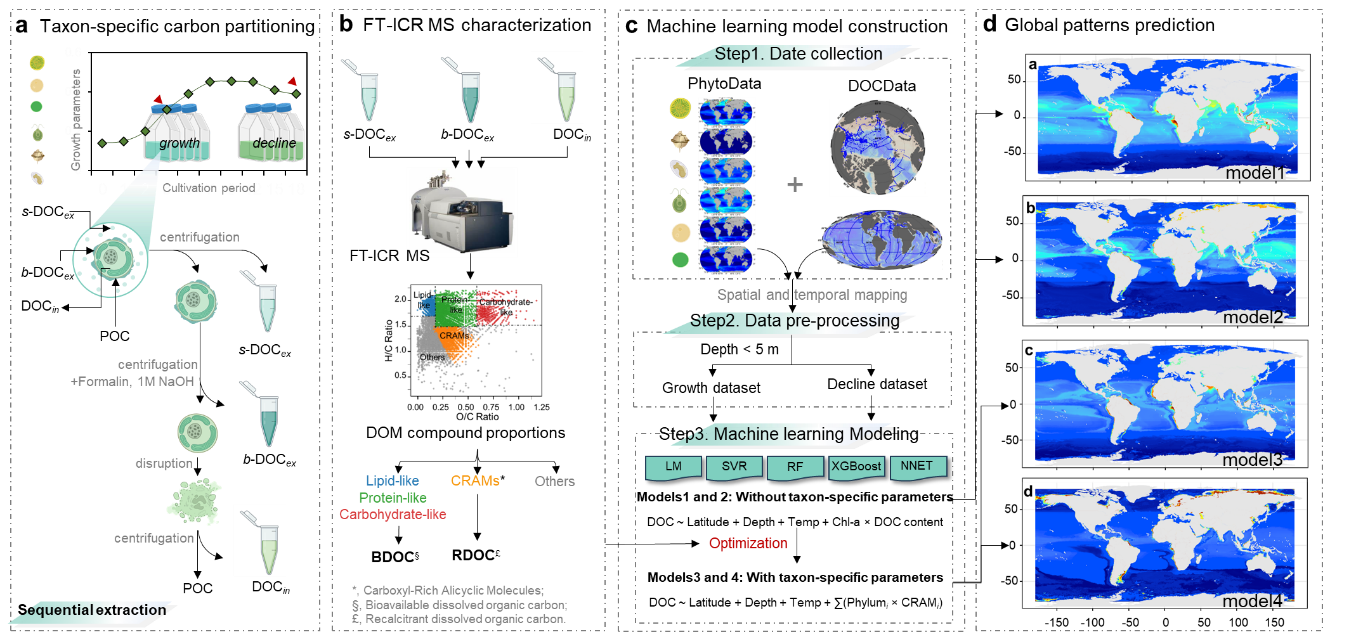
Schematic diagram of the technical route for this study.(Imaged by LU Zhe et al)
<関連情報>
- https://english.cas.cn/newsroom/research_news/life/202508/t20250821_1051170.shtml
- https://www.nature.com/articles/s41467-025-63105-x
植物プランクトンが全球の海洋溶存有機炭素プール構造化に果たす役割 The role of phytoplankton in structuring global oceanic dissolved organic carbon pools
Zhe Lu,Guoming Qin,Lingling Zheng,Yanyan Zhang,Lincheng Huang,Jinge Zhou,Yongxin Liu,Mianhai Zheng,Enqing Hou,Lirong Song,Hongbin Liu,Nianzhi Jiao & Faming Wang
Nature Communications Published:20 August 2025
DOI:https://doi.org/10.1038/s41467-025-63105-x
Abstract
Phytoplankton-derived dissolved organic carbon (DOC) is a major pathway for atmospheric CO2 transfer to long-lived oceanic DOC reservoirs. Yet, current models rarely accounted for its molecular and taxonomic heterogeneity across growth seasons. Here, using ultra-high-resolution mass spectrometry (FT-ICR MS), we characterized DOC molecular signatures across diverse algal taxa. Recalcitrant DOC accounted for over 10% of their total organic carbon in all algal groups, highlighting a widespread and previously underappreciated trait. Additionally, we integrated these signatures with satellite-derived, taxon-resolved chlorophyll-a concentrations to develop machine learning models for predicting overall surficial DOC concentrations. Including taxon-specific carbon allocation markedly improved model performance (R2 = 0.92 and 0.80 for the growth and decline phases, respectively), substantially outperforming models without such data (R2 = 0.69 and 0.46). Furthermore, leveraging these optimized models, we generated a global marine DOC dataset and found that diatoms explained up to 63.8% of the variance in surface DOC. We further showed that algal recalcitrant DOC production was significantly higher during growth than decline seasons globally. These findings offer insights into how bloom duration and climate-driven shifts in phytoplankton composition reshape oceanic DOC dynamics.