2025-07-15 東京科学大学
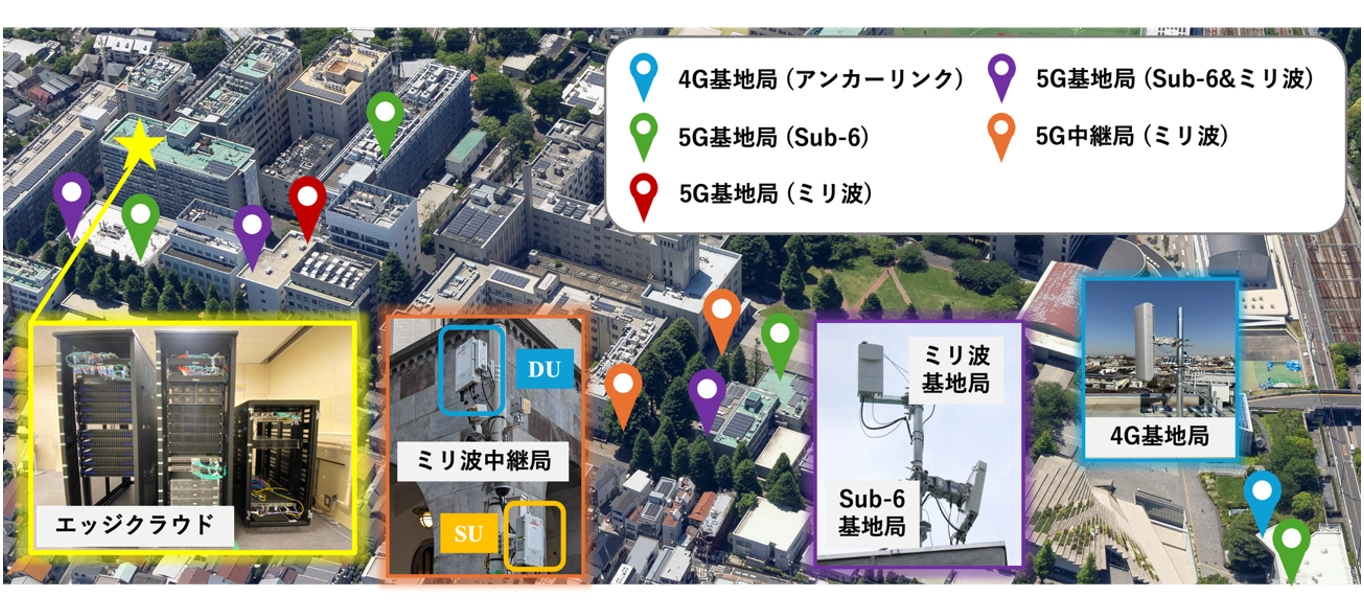
図1. 大岡山5G/6G実証フィールド
<関連情報>
- https://www.isct.ac.jp/ja/news/5hle9sbfgsg7
- https://www.isct.ac.jp/plugins/cms/component_download_file.php?type=2&pageId=&contentsId=1&contentsDataId=1918&prevId=&key=951dccd0efe961bc7ccf8a0a38d0d02b.pdf
- https://ieeexplore.ieee.org/document/10971397
様々なトポロジーにおける5G mmWaveリレーのフィールド評価: NLOSカバレッジの向上と閉塞に対する耐性 Field Evaluation of 5G mmWave Relays in Various Topologies: NLOS Coverage Enhancement and Tolerance Against Blockage
Naoya Okubo; Keishi Tokugawa; Jin Nakazato; Suwen Ke; Yiming Chen; Gia Khanh Tran,…
IEEE Access Published:21 April 2025
DOI:https://doi.org/10.1109/ACCESS.2025.3562737
Abstract:
As time progresses, the use of higher frequencies becomes increasingly necessary due to the growing issue of frequency congestion. While discussions are ongoing regarding the potential use of millimeter-wave (mmWave) frequencies introduced in 5G for the Beyond 5G (B5G) / 6G era, the deployment of 5G mmWave networks has remained limited and less widespread. In addition, some countries and regions have already halted mmWave frequency allocations or paused base station installations. The primary reasons for this are the limited coverage of mmWave, which makes widespread deployment cost-ineffective, and the limited availability of mmWave-compatible devices. Therefore, this paper addresses the coverage challenges associated with mmWave to encourage the future adoption of higher frequencies. One promising technology for expanding coverage is analog relay stations (RSs), which offer a relatively low-cost and efficient approach to network area design. This technology has been extensively studied. However, in the mmWave band, the propagation environment is particularly challenging due to factors such as beamforming, blockage, and scattering caused by obstacles like trees and foliage. In this study, we conduct experimental evaluations of coverage enhancement and communication quality improvement by installing analog RSs within the B5G demonstration field at the Ookayama Campus of the Institute of Science Tokyo (formerly Tokyo Institute of Technology). The evaluations include a comprehensive assessment of the impacts of NLOS coverage enhancement using various relay topologies and improved tolerance against blockage, providing practical guidelines for deploying RSs in real-world environments.