2026-11-04 合肥物質科学研究院(HFIPS)
中国科学院合肥物質科学研究院のZHANG Zhirong氏らの研究チームは、高感度と広い測定範囲を両立する新しい二酸化炭素(CO₂)センサーを開発した。本技術は、二重偏光・単一三角形共振器型キャビティリングダウン分光法(DPS-CRDS)を採用し、同一の光共振器内でS偏光とP偏光の2種類の光を利用する。S偏光は低濃度のCO₂検出に高い感度を示し、P偏光は高濃度の測定に適している。両者を組み合わせることで、50~10,000ppmの濃度範囲を測定でき、S偏光のみを使用する従来方式と比較して測定範囲を10倍以上に拡大した。実環境試験では、室内の在室人数や換気状況による濃度変化、および屋外大気中のCO₂濃度の日変動を連続的に捉えることに成功した。測定波長や光共振器を調整することで他のガスにも応用でき、室内空気質の監視や大気環境観測への展開が期待される。
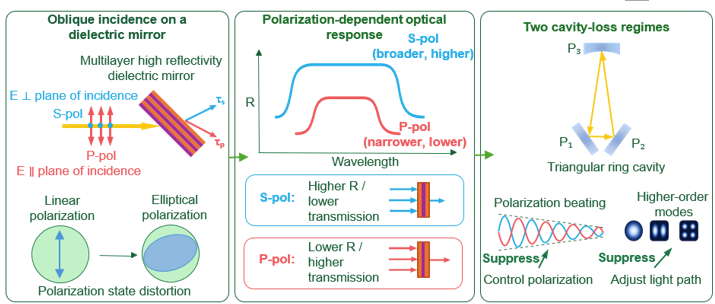
DPS-CRDS system high-sensitivity wide-range CO2 monitoring (Image by LIN Yuqing)
<関連情報>
- https://english.hf.cas.cn/nr/rn/202611/t20261104_1213154.html
- https://www.sciencedirect.com/science/article/abs/pii/S092540052601703X
高感度かつ広いダイナミックレンジのCO₂モニタリングを可能にする二重偏波キャビティリングダウンセンサー A dual-polarization cavity ring-down sensor enabling high sensitivity and wide dynamic range CO₂ monitoring
Yuqing Lin,Shengnan Liu,Tianyu Mao,Wenjie Jia,Hua Xia,Pengshuai Sun,Huadong Wang,Xinyu Zhang,Bian Wu,Tao Pang,Zhirong Zhang
Sensors and Actuators B: Chemical Available online: 22 October 2026
DOI:https://doi.org/10.1016/j.snb.2026.141124
Highlights
- Dual polarization establishes two cavity-loss regimes in one ring cavity.
- The sensor reconciles sensitivity with wide-range CO₂ detection.
- CO₂ concentrations from 50 to 10,000 ppm are quantitatively measured.
- Complementary channels cover atmospheric and elevated CO₂ levels.
- Field measurements demonstrate practical continuous CO₂ monitoring
Abstract
Monitoring CO₂ across urban atmospheric and elevated indoor levels requires both high sensitivity and tolerance to strong absorption, which are difficult to achieve simultaneously using a single cavity-loss condition in conventional cavity ring-down spectroscopy (CRDS). Here, we develop a dual-polarization single-cavity CRDS (DPS-CRDS) sensor that exploits polarization-dependent mirror reflectivity at oblique incidence to establish two complementary loss regimes within one triangular cavity. The low-loss S-polarization channel provides a longer ring-down time for sensitive urban atmospheric measurements, whereas the higher-loss P-polarization channel maintains measurable signals at elevated CO₂ concentrations. Allan deviation analysis yields minimum detectable absorption coefficients of 5.57 × 10⁻¹ ² and 5.21 × 10⁻¹ ¹ cm⁻¹ for the S and P-polarization channels, respectively. Together, the channels enable quantitative CO₂ measurements from 50 to 10,000 ppm. Continuous measurements tracked occupancy and ventilation driven indoor CO₂ variations and resolved an urban atmospheric diurnal cycle that corresponded with changes in boundary layer height, wind speed, and solar irradiance. The proposed strategy therefore mitigates the sensitivity–dynamic range trade-off of conventional CRDS and enables wide range CO₂ monitoring within a single cavity.’