2026-07-09 新潟大学
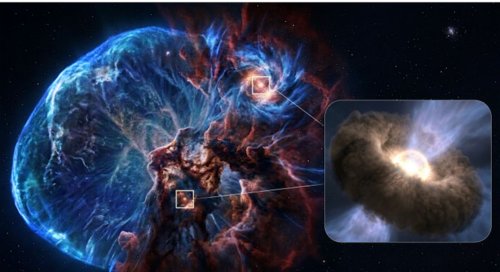
図1. 超新星残骸に発見された星の赤ちゃんを包む暖かい分子ガスのゆりかご(ホットコア)の想像図。青色は超新星爆発により生じた高エネルギー粒子や光子、茶色は星間物質を表している。 クレジット:下西隆(新潟大学)[本研究の観測結果に基づき、Google GeminiおよびChatGPTによる描画支援を利用]
<関連情報>
- https://www.niigata-u.ac.jp/news/2026/1170751/
- https://www.niigata-u.ac.jp/wp-content/uploads/2026/07/20260709rs-1-.pdf
- https://iopscience.iop.org/article/10.3847/1538-4357/ae6fba
最近の超新星フィードバック下における分子複雑性の存続:RX J1713.7−3946におけるホットコアの検出 Survival of Molecular Complexity under Recent Supernova Feedback: Detection of Hot Cores in RX J1713.7−3946
Takashi Shimonishi, Hidetoshi Sano, Kenji Furuya, and Yoko Oya
The Astrophysical Journal Published: 2026 July 1
DOI:10.3847/1538-4357/ae6fba
Abstract
Protostellar cores located near supernova remnants (SNRs) are considered potential analogs of the birth environment of the solar system. However, the extent to which supernovae influence their chemical evolution remains unclear. We report the first detection of hot molecular cores in an SNR using the Atacama Large Millimeter/submillimeter Array. The detected hot cores (HC1 and HC2) are located inside the X-ray shell of the young SNR RX J1713.7−3946, and both sources are associated with Class I intermediate-mass protostars. This paper focuses on a detailed chemical analysis of HC1, in which a variety of carbon-, oxygen-, nitrogen-, sulfur-, and silicon-bearing species are detected. Excitation analyses indicate that HC1 harbors dense (∼107 cm−3), compact (<500 au), and high-temperature (≳100 K) molecular gas. Despite being located within a supernova-feedback region, the column density ratios of complex organic molecules (HCOOCH3/CH3OH, CH3OCH3/CH3OH, and CH3CHO/CH3OH), a deuterated molecule (CH2DOH/CH3OH), and sulfur- and nitrogen-bearing species (OCS/CH3OH and C2H5CN/CH3CN) in HC1 are indistinguishable from those observed in hot cores/corinos in more typical star-forming environments. HC1 is located near the outer edge of the supernova shell, and the surrounding region has likely begun to be exposed to such a harsh environment only recently. The elapsed time since the onset of exposure to high-energy particles and photons may be too short for the chemical composition of the hot core to be significantly altered, and/or the hot core region may be shielded by magnetic fields amplified by supernova feedback, which could suppress the penetration of enhanced cosmic rays.