2026-04-13 産業技術総合研究所
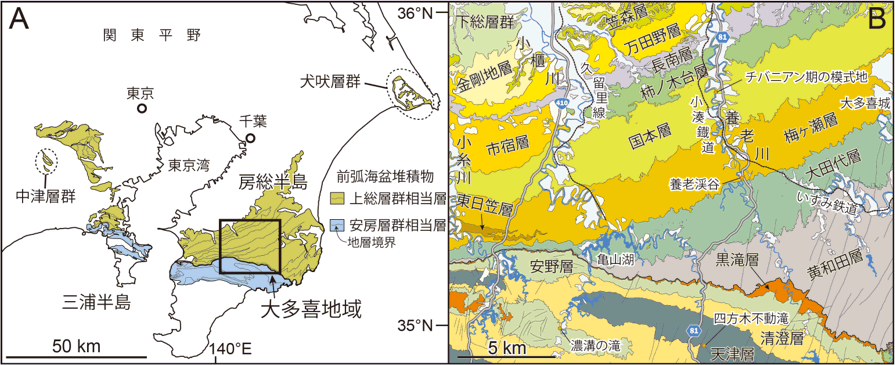
(A)大多喜地域の位置図(B)大多喜図幅内の地質概略図(5万分の1地質図幅「大多喜」より引用)
<関連情報>
- https://www.aist.go.jp/aist_j/press_release/pr2026/pr20260413/pr20260413.html
- https://link.springer.com/article/10.1186/s40645-023-00558-y
- https://www.jstage.jst.go.jp/article/bullgsj/70/6/70_373/_article/-char/ja/
火山灰層序と生物層序によって明らかになった、中部日本における鮮新世~更新世前弧海盆の海盆規模の侵食と分断 Basin-wide erosion and segmentation of the Plio-Pleistocene forearc basin in central Japan revealed by tephro- and biostratigraphy
Masayuki Utsunomiya,Itoko Tamura,Atsushi Nozaki & Terumasa Nakajima
Progress in Earth and Planetary Science Published:17 May 2023
DOI:https://doi.org/10.1186/s40645-023-00558-y This article has been updated
Abstract
The basement of the Tokyo metropolitan area consists of the Miocene–Pleistocene forearc basin fills that are well exposed around Tokyo Bay, especially on the Miura and Boso peninsulas. The forearc basin fills on these two peninsulas are called the Miura and Kazusa groups, and they were deposited during the late Miocene–Pliocene and Pliocene–middle Pleistocene, respectively. Because many biostratigraphic datum planes, paleomagnetic reversal events, and other chronostratigraphic tools are available for these deposits, they provide the “type stratigraphy” of other equivalent sedimentary sequences on the Japanese islands and in the northwest Pacific. However, the use of such stratigraphic markers has not been fully applied to understand the architecture of a basin-wide unconformity between the Miura and Kazusa groups called the Kurotaki unconformity. For our study, we made correlations among the Pliocene vitric tephra beds based on their stratigraphic levels, lithologic characteristics, the chemical compositions of glass shards, and calcareous nannofossil biostratigraphy. As a result, we were able to correlate tephra beds Ng-Ky25 just above the C3n.3n normal subchronozone (4.7 Ma), IkT16-An157.5 and IkT19-An158.5 near the top of the Mammoth reverse polarity subchronozone (3.21 Ma), and Ahn-Onr (2.6–2.7 Ma) across Tokyo Bay on the Miura and Boso peninsulas. We were able to recognize erosional surfaces and coeval mass-transport deposits immediately below the top of the Mammoth reverse polarity subchronozone, which suggests that submarine landslide(s) may have produced the lack of stratigraphic horizons (4.5–3.2 Ma) in the Miura and eastern Boso regions. Basal pebbly sandstone beds pervasively cover the erosional surfaces, and they show lateral variations into the thick (up to 60 m) mass-transport deposits and overlying turbidite sandstones. The lateral variations in sediment thickness of the post-failure deposits suggest that the basin-wide erosion was associated with the initial growth of a basin-bounding structural high that separates two distinct sub-basins in the forearc basin, which resulted in the subsequent onlapping deposition in the earliest stage of the Kazusa forearc basin. The basin-wide erosion marks the initiation of tectonic reconfigurations that led to segmentation of the forearc basin around the Tokyo Bay region.
下部更新統上総層群黄和田層下部~中部に挟まれるテフラ層の層位と特徴
宇都宮 正志 , 水野 清秀, 田村 糸子
地質調査研究報告 発行日: 2019/12/26
DOI:https://doi.org/10.9795/bullgsj.70.373
抄録
房総半島中央部~東部における上総層群黄和田層のテフラ層の層位と特徴を明らかにし,現地でのテフラ層の同定に有用なルートマップ,柱状図,露頭写真を示した.また,一部のテフラ層について主成分及び微量成分の元素組成分析を行った.その結果,未確定であった黄和田層中部~上部の広域テフラの上下関係が明確になり,未報告であった多くのガラス質テフラ層の記載岩石学的及び化学的特徴が明らかとなった.本研究によって,南関東地方のみならず日本列島の下部更新統の模式的なテフラ層序の一部が整備され,更新世前期の火山活動の変遷を知る上で基盤的な情報が得られた.