2026-03-23 スタンフォード大学
<関連情報>
- https://news.stanford.edu/stories/2026/03/lithium-ion-batteries-longer-lasting-atomic-disorder
- https://www.nature.com/articles/s41560-025-01910-w
ドーパントフリーLiNi0.9Mn0.1O2カソードにおける格子崩壊を電気化学的に誘起された部分的なカチオン無秩序によって抑制する Eliminating lattice collapse in dopant-free LiNi0.9Mn0.1O2 cathodes via electrochemically induced partial cation disorder
Junghwa Lee,Zhelong Jiang,Nicolas B. Liang,Jin Hwan Kwak,Howie Nguyen,Grace M. Busse,Yiseul Yoo,Hari Ramachandran,Kipil Lim,Peter M. Csernica,Tianyi Li,Xin Xu,Kyung Yoon Chung,Kathrin Michel,Joop E. Frerichs,William E. Gent,Raphaële J. Clément,Jungjin Park & William C. Chueh
Nature Energy Published:27 November 2025
DOI:https://doi.org/10.1038/s41560-025-01910-w
Abstract
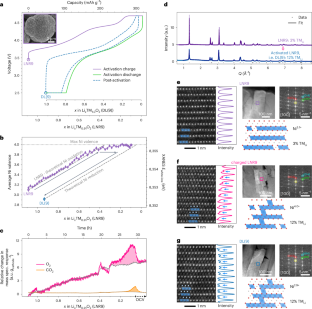
Layered oxide cathodes for lithium-ion batteries typically undergo large expansion and contraction during cycling, including a particularly abrupt shrinkage along the c lattice (c-collapse) at high states of charge, which limits their lifetime. Here we suppress the c-collapse in compositionally simple LiNi0.9Mn0.1O2 by electrochemically inducing partial disorder that is permanently retained throughout the bulk. Our approach leverages irreversible oxygen oxidation in Li-excess Ni-rich oxides to activate partial disordering of the cation sublattice, while preserving the long-range layered structure. By varying the initial Li-excess, we obtain Li-stoichiometric transition-metal oxides with tunable cation disorder. Surprisingly, when the concentration of transition-metal ions occupying Li sites (TMLi) reaches ≥12%, the c-lattice parameter remains nearly invariant during (de)lithiation, reducing chemical strain, preserving microstructural integrity and extending battery cycle life. The resulting material displays high specific capacity, long-term stability, small voltage hysteresis and negligible voltage decay. This concept opens the possibility of designing materials by inducing persistent intrinsic disorder electrochemically.