2026-03-26 ミュンヘン大学(LMU)
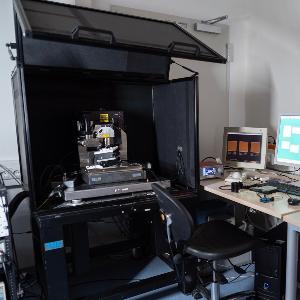
Quantum Twisting Microscope in Munich | © MCQST
<関連情報>
- https://www.lmu.de/en/newsroom/news-overview/news/twisting-into-focus-a-highly-sensitive-quantum-microscope-89fc77c9.html
- https://pubs.acs.org/doi/10.1021/acs.nanolett.5c05015
量子ねじり顕微鏡を用いた室温におけるグラフェン中の電子間相互作用の解明 Revealing Electron–Electron Interactions in Graphene at Room Temperature with a Quantum Twisting Microscope
M. Lee,I. Das,J. Herzog-Arbeitman,J. Papp,J. Li,M. Daschner,Z. Zhou,M. Bhatt,M. Currle,J. Yu,Y. Jiang,M. Becherer,R. Mittermeier,P. Altpeter,C. Obermayer,H. Lorenz,G. Chavez,B. T. Le,J. Williams,K. Watanabe,T. Taniguchi,B. A. Bernevig,D. K. Efetov
Nano Letters Published: March 16, 2026
DOI:https://doi.org/10.1021/acs.nanolett.5c05015
Abstract
A quantum twisting microscope (QTM) enables energy- and momentum-resolved measurements of quantum phases through tunneling spectroscopy in twistable van der Waals heterostructures. Here, we improve its resolution and extend its range to higher energies and twist angles by integrating hexagonal boron nitride as a tunneling dielectric. This advance reveals previously inaccessible dispersion features in tunneling between two monolayer graphene sheets, consistent with a logarithmic correction to the linear Dirac spectrum arising from electron–electron interactions, with a fine-structure constant α ≈ 0.32 ± 0.01. Remarkably, these extremely subtle corrections are resolved even at room temperature. Our results highlight the exceptional sensitivity of the QTM, where interferometric interlayer tunneling amplifies small band-structure modifications. They further show that strong electron–electron interactions persist in symmetric, nonordered graphene states and demonstrate the QTM’s capability to probe spectral functions and excitations of correlated ground states across twisted and untwisted two-dimensional systems.