2026-03-26 合肥物質科学研究院(HFIPS)
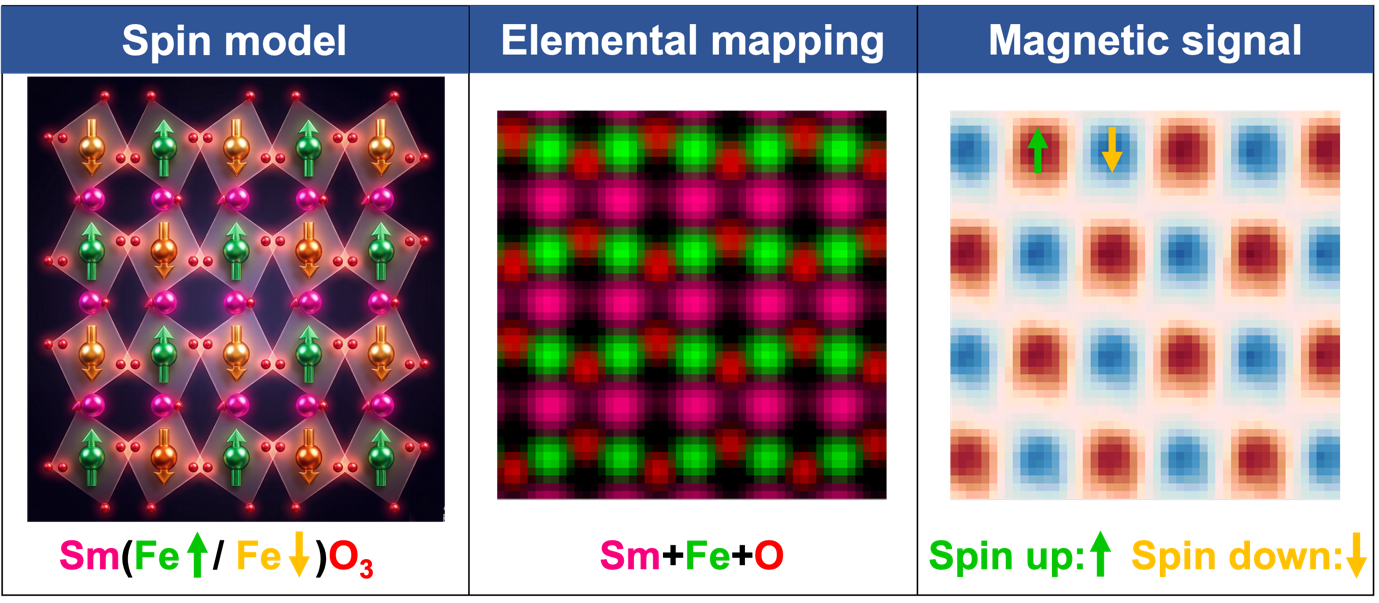
Atomic spin model of SmFeO3 (left), atomic-resolution elemental distribution (middle), and atomic-resolution magnetic signal (right). (Image by LIU Yizhou)
<関連情報>
- https://english.hf.cas.cn/nr/rn/202603/t20260326_1153816.html
- https://www.nature.com/articles/s41565-026-02134-z
埋没界面における原子スケール反強磁性秩序の磁気円二色性イメージング Magnetic circular dichroism imaging of atomic-scale antiferromagnetic order at a buried interface
Dongsheng Song,Fengshan Zheng,Lin Hao,Lei Jin,Yajiao Ke,Yizhou Liu,Mingliang Tian,Binghui Ge,Rafal E. Dunin-Borkowski & Haifeng Du
Nature Nanotechnology Published:23 March 2026
DOI:https://doi.org/10.1038/s41565-026-02134-z
Abstract
Magnetic circular dichroism utilizing electrons or X-rays serves as a powerful tool for the investigation of magnetism in ferromagnets, but antiferromagnets pose a severe challenge to the technique due to their vanishing net magnetization. Although transmission electron microscopy has demonstrated the atomic-scale characterization of antiferromagnetism using elastically scattered electrons, separating the weak magnetic signal from the dominant electrostatic background remains challenging, and applicability is largely limited to perfect crystals. Here we develop atomic-column-resolved electron magnetic circular dichroism to resolve antiferromagnetic order using a scanning transmission electron microscope. By exploiting chirality around individual magnetic atomic columns, we localize the magnetic circular dichroism signals around the transmitted electron beam with enhanced strength and signal-to-noise ratio, enabling atomic-column magnetic measurements. Applying this technique to antiferromagnets, we not only distinguish the characteristic G-type and C-type antiferromagnetic orderings in DyFeO3 and α-Fe2O3 but also identify a one-unit-cell-thick magnetic dead layer at the buried DyScO3–SmFeO3 interface. Our work establishes a readily accessible method for atomic-scale magnetic order mapping, with potential applications in fields such as interfacial magnetism, topological magnetism, antiferromagnetism and altermagnetism.