2026-03-24 国際農林水産業研究センター,新潟大学名古屋大学
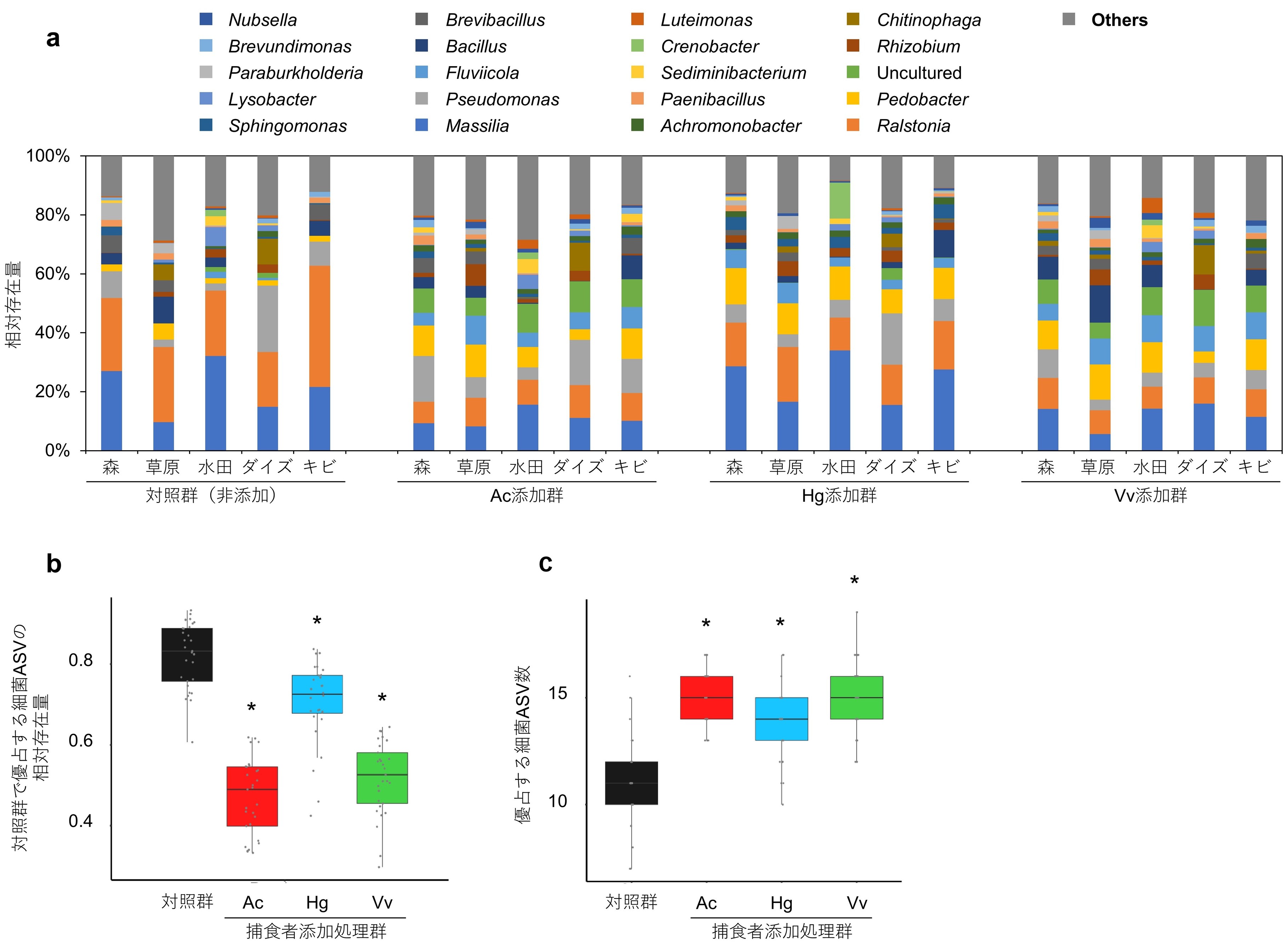
図1 マイクロコズム実験における細菌群集組成の変化
<関連情報>
- https://www.jircas.go.jp/ja/release/2025/press202530
- https://www.nature.com/articles/s41467-026-70605-x
捕食者を介した局所的な収束が、世界的な微生物群集の多様化を促進する Predator-mediated local convergence fosters global microbial community divergence
Rasit Asiloglu,Hayato Kuno,Mayu Fujino,Seda Bodur,Murat Aycan,Haruka Ishizuka,Shiori Kazama,Shinya Iwasaki,Jun Murase,Naoki Harada,Miwa Arai & Kenta Ikazaki
Nature Communications Published:18 March 2026
DOI:https://doi.org/10.1038/s41467-026-70605-x
Abstract
Understanding how microbial communities assemble is central to predicting ecosystem function. Although predators strongly influence bacterial communities through predation, the role of microbial predators in modulating global microbial divergence and convergence patterns remains largely neglected. Here, we integrated global-scale amplicon sequencing data, controlled field experiments, and reconstructions of natural and synthetic communities to examine predator-mediated community assembly mechanisms. We show that bacterivorous protists exert dual, scale-dependent effects on microbial communities: promoting local convergence by suppressing dominant bacterial taxa, while generating global divergence through species-specific predation effects. We find that predator identity and prey susceptibility jointly determine convergence outcomes. Communities dominated by predator-resistant taxa exhibit reduced convergence under predation pressure, revealing a predictable trait-based filtering mechanism. This work establishes bacterivorous protists as key, context-dependent agents of biogeography and suggests new opportunities for microbiome engineering, where targeted use of protists may steer microbial communities toward functional configurations that enhance soil health and ecosystem resilience.