2026-02-04 マサチューセッツ工科大学(MIT)
<関連情報>
- https://news.mit.edu/2026/terahertz-microscope-reveals-motion-superconducting-electrons-0204
- https://www.nature.com/articles/s41586-025-10082-2
2次元超伝導体におけるテラヘルツ超流動プラズモンの画像化 Imaging a terahertz superfluid plasmon in a two-dimensional superconductor
A. von Hoegen,T. Tai,C. J. Allington,M. Yeung,J. Pettine,M. H. Michael,E. Viñas Boström,X. Cui,K. Torres,A. E. Kossak,B. Lee,G. S. D. Beach,G. D. Gu,A. Rubio,P. Kim & N. Gedik
Nature Published:04 February 2026
DOI:https://doi.org/10.1038/s41586-025-10082-2
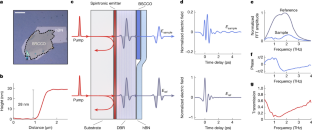
Abstract
The superconducting gap defines the fundamental energy scale for the emergence of dissipationless transport and collective phenomena in a superconductor1,2,3. In layered high-temperature cuprate superconductors, in which the Cooper pairs are confined to weakly coupled two-dimensional (2D) copper–oxygen (CuO2) planes4,5, terahertz (THz) spectroscopy at subgap millielectronvolt (meV) energies has provided crucial insights into the collective superfluid response perpendicular to the superconducting layers6,7,8,9. However, within the CuO2 planes, the collective superfluid response manifests as plasmonic charge oscillations at energies far exceeding the superconducting gap, obscured by strong dissipation2,6,9,10. Here we present spectroscopic evidence of a below-gap, 2D superfluid plasmon in few-layer Bi2Sr2CaCu2O8+x and spatially resolve its deeply subdiffractive THz electrodynamics. By placing the superconductor in the near field of a spintronic THz emitter, we reveal this distinct resonance—absent in bulk samples and observed only in the superconducting phase—and determine its plasmonic nature by mapping the geometric anisotropy and dispersion. Crucially, these measurements offer a direct view of the momentum-dependent and frequency-dependent superconducting transition in two dimensions.