2026-01-21 ジョージア工科大学(Georgia Tech)
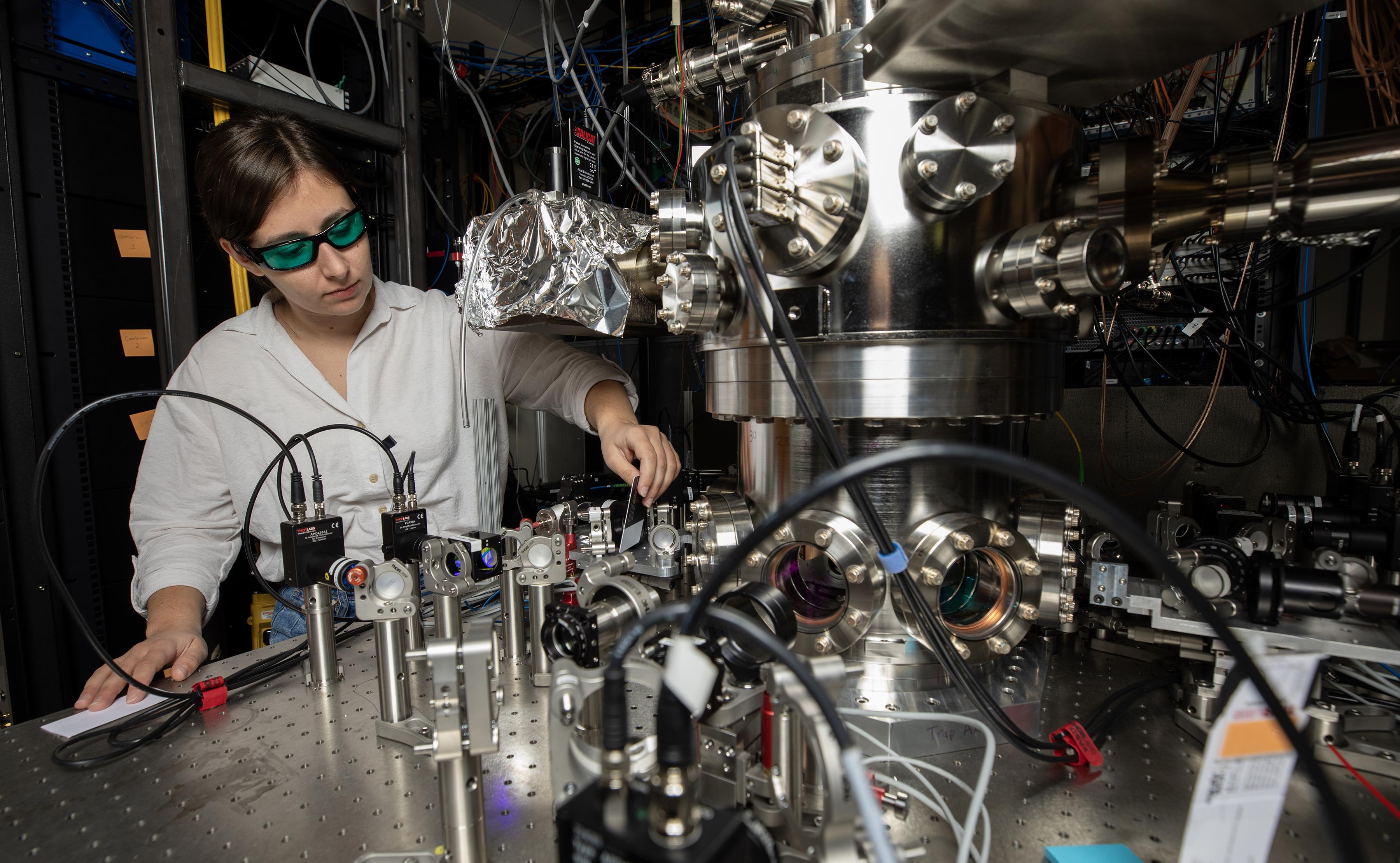
GTRI Research Scientist Darian Hartsell makes adjustments to an improved cryogenic vacuum chamber that helps reduce some common noise sources by isolating ions from vibrations and shielding them from magnetic field fluctuations. (Credit: Sean McNeil, GTRI)
<関連情報>
- https://research.gatech.edu/new-cryogenic-vacuum-chamber-cuts-noise-quantum-ion-trapping
- https://pubs.aip.org/aip/apl/article-abstract/128/3/034001/3377639/Design-and-characterization-of-a-cryogenic-vacuum
イオントラッピング実験用極低温真空チャンバーの設計と特性評価
Design and characterization of a cryogenic vacuum chamber for ion trapping experiments
D. M. Hartsell;J. M. Gray;C. M. Shappert;N. L. Gostin;R. A. McGill;H. N. Tinkey;C. R. Clark;K. R. Brown
Applied Physics Letters Published:January 20 2026
DOI:https://doi.org/10.1063/5.0304948
We present the design and characterization of a cryogenic vacuum chamber incorporating mechanical isolation from vibrations, a high numerical-aperture in-vacuum imaging objective, in-vacuum magnetic shielding, and an antenna for global radio frequency manipulation of trapped ions. The cold shield near 4 K is mechanically referenced to an underlying optical table via thermally insulating supports and exhibits root mean square vibrations less than 7.61(4) nm. Using the in-vacuum objective, we can detect 397 nm photons from a trapped 40Ca+ ion with 1.77% efficiency and achieve 99.9963(4)% single-shot state-detection fidelity in 50 μs. To characterize the efficacy of the magnetic shields, we perform Ramsey experiments on the ground-state qubit and obtain a coherence time of 24(2) ms, which extends to 0.25(1) s with a single spin-echo pulse. XY4 and XY32 dynamical decoupling sequences driven via the radio frequency antenna extend the coherence to 0.72(2) and 0.81(3) s, respectively.