
2025-11-20 筑波大学
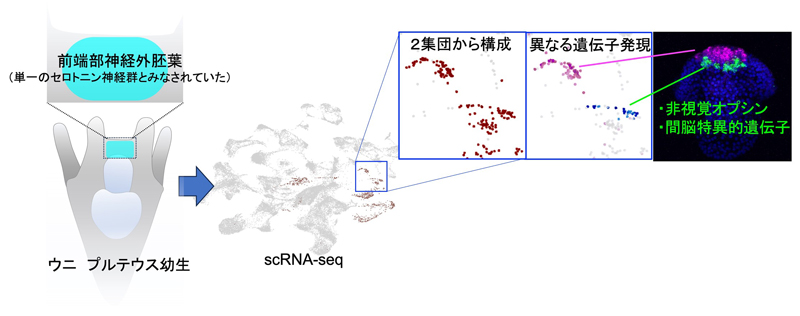
図1 (左)ウニ幼⽣を背側から⾒た模式図。前端部(⽔⾊)領域は前端部神経外胚葉、つまり脊索動物でいうところの脳領域に類似する。しかし、発⽣初期にここに存在するセロトニン神経は単⼀のタイプとされ、それほど複雑さはないとみなされていた。(右)この脳領域に対して scRNA-seq を⾏ったところ、セロトニン神経が2集団から構成され、それぞれ異なる遺伝⼦発現をしていることが明らかになった。特に体の後⽅背側に位置する集団は⾮視覚オプシンとともに、脊索動物では間脳形成に関与している遺伝 ⼦群が発現していることが明らかになった。
<関連情報>
- https://www.tsukuba.ac.jp/journal/biology-environment/20251120141500.html
- https://www.tsukuba.ac.jp/journal/pdf/p20251120141500.pdf
- https://www.nature.com/articles/s41467-025-65628-9
ウニ幼生における非視覚光受容に関与する脳領域の形成 Non-visual photoreceptive brain specification in sea urchin larvae
Junko Yaguchi,Koki Tsuyuzaki,Ikutaro Sawada,Atsushi Horiuchi,Naoaki Sakamoto,Takashi Yamamoto,Takahiro Yamashita & Shunsuke Yaguchi
Nature Communications Published:19 November 2025
DOI:https://doi.org/10.1038/s41467-025-65628-9
Abstract
Centralized nervous systems enable animals to detect environmental cues and coordinate behavior, but their evolutionary origins in deuterostomes remain unclear. Among deuterostomes, echinoderms—such as sea urchins—have long been thought to lack brain-like structures, especially in larval stages. Although recent gene expression and neural activity studies suggest brain-like properties in sea urchin larvae, direct links to behavior are still emerging. Here, we identify a light-sensitive cluster of neurons in the posterior neuroectoderm of sea urchin larvae. These neurons express UV-sensitive Opsin5 and regulatory genes such as rx, otx, six3, and lhx6, which are conserved in the vertebrate diencephalon. We mapped this domain using single-cell RNA sequencing and in situ hybridization. Knockdown of Opn5L impaired light-dependent swimming, indicating an active role in photoreception. While further work is needed to fully establish circuit-to-behavior relationships, our findings add to growing evidence that sea urchin larvae possess a non-visual photoreceptive neural center with molecular features shared by vertebrate brain regions. This suggests that such domains originated in the deuterostome ancestor and contributed to the early evolution of brain function.

