2025-06-09 神戸大学
神戸大学などの研究チームは、ナス科植物が根から分泌する「ソラノエクレピンC(SEC)」を発見。SEC自体はジャガイモシストセンチュウの孵化を促さないが、土壌微生物によって変換されることで孵化促進物質に変化することが明らかにされた。SECは窒素やリン欠乏時に多く分泌され、植物が環境に応じて微生物との相互作用を通じた戦略を持つことを示唆。この知見は新たな線虫防除技術の基盤となる可能性がある。
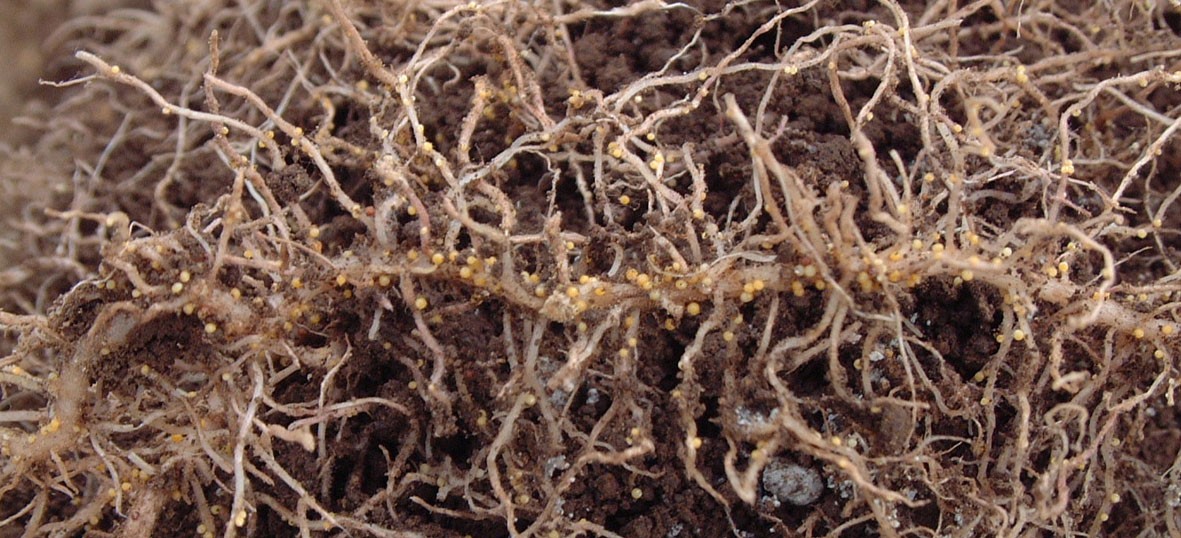 ジャガイモの根に寄生するジャガイモシストセンチュウの雌成虫(黄色の丸い粒。直径約0.7mm)
<関連情報>
- https://www.kobe-u.ac.jp/ja/news/article/20250609-66707/
- https://nph.onlinelibrary.wiley.com/doi/10.1111/nph.70252
根圏微生物によってジャガイモシストセンチュウの孵化因子に変換される根分泌分子ソラノエクレピンC Solanoeclepin C, a root-secreted molecule converted by rhizosphere microbes to hatching factors for potato cyst nematodes
Ryota Akiyama, Yui Kawano, Kosuke Shimizu, Soichiro Makino, Karen Akanuma, Haru Nagatomo, Masami Yokota Hirai, Yukihiro Sugimoto, Atsuhiko Kushida, Keiji Tanino, Masaharu Mizutani
New Phytologist Published: 26 May 2025
DOI:https://doi.org/10.1111/nph.70252
Summary
- Eclepins are root-secreted compounds that induce the hatching of cyst nematodes. Solanoeclepin A (SEA) and B (SEB) have been isolated as potent hatching factors for potato cyst nematodes (PCNs). SEB is biosynthesized in roots, released into the rhizosphere, and converted into SEA by soil microorganisms. However, given that SEB and SEA exhibit comparable hatching-inducing activity toward PCNs, the ecological significance of microbial solanoeclepin metabolism in eclepin-mediated communication remains unclear.
- In this study, we identified solanoeclepin C (SEC), a previously unrecognized solanoeclepin secreted by tomato and potato roots. Structural analysis revealed that SEC is an acetylated derivative of SEB. Soil incubation experiments demonstrated that SEC is converted into SEB and subsequently into SEA. SEC exhibits 10 000-fold lower hatching-inducing activity than SEA.
- Gene expression analysis in hydroponically grown tomatoes showed that solanoeclepin biosynthesis is upregulated under nitrogen and phosphorus deficiencies, with nitrogen starvation having the strongest effect.
- Our results demonstrate that although SEC itself exhibits low hatching-inducing activity, it is converted by soil microorganisms into SEB and SEA, which are then exploited by PCNs to trigger their hatching. These findings reveal a previously unrecognized three-way interaction among plants, soil microbes, and nematodes mediated by solanoeclepins.