
2025-11-21 名古屋大学
<関連情報>
- https://www.nagoya-u.ac.jp/researchinfo/result/2025/11/post-903.html
- https://www.nagoya-u.ac.jp/researchinfo/result/upload_images/20251121_imass.pdf
- https://earth-planets-space.springeropen.com/articles/10.1186/s40623-025-02317-3
2024年5月の超磁気嵐時のプラズマ圏と電離圏における電子密度の時間的・空間的変動の特徴 Characteristics of temporal and spatial variation of the electron density in the plasmasphere and ionosphere during the May 2024 super geomagnetic storm
Atsuki Shinbori,Naritoshi Kitamura,Kazuhiro Yamamoto,Atsushi Kumamoto,Fuminori Tsuchiya,Shoya Matsuda,Yoshiya Kasahara,Mariko Teramoto,Ayako Matsuoka,Takuya Sori,Yuichi Otsuka,Michi Nishioka,Septi Perwitasari,Yoshizumi Miyoshi & Iku Shinohara
Earth, Planets and Space Published:20 November 2025
DOI:https://doi.org/10.1186/s40623-025-02317-3
Abstract
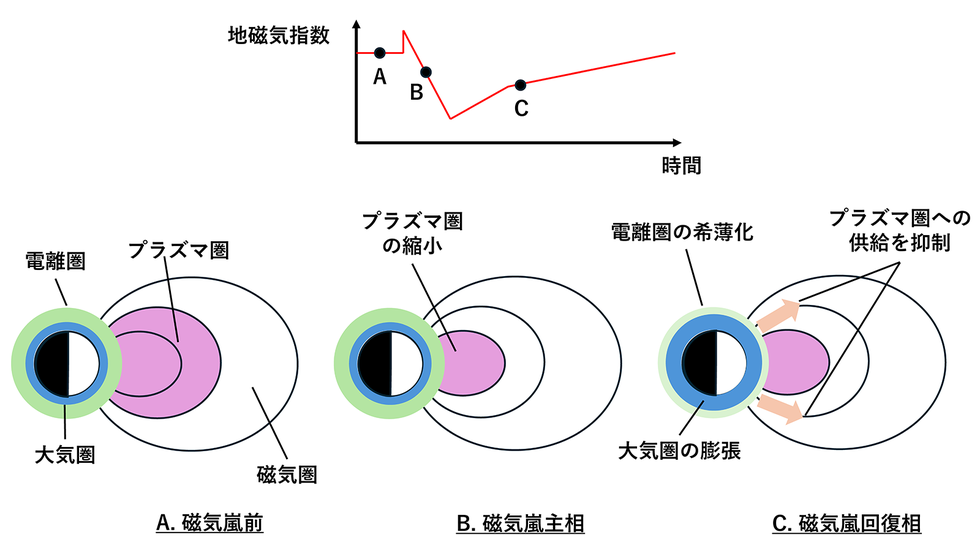
The spatial distribution of electron density in the ionosphere exhibits notable variability and undergoes considerable changes during storms and substorms driven by solar wind disturbances. Electron density variations and irregularities can cause total signal blackouts of broadcast waves during strong scintillation periods and enhance satellite positioning errors. We analyzed Global Navigation Satellite System (GNSS)—total electron content (TEC) and Arase satellite observation data to elucidate the characteristics of the electron density variation in the plasmasphere and ionosphere during the May 2024 super storm. To identify the electron density variation in the ionosphere, we calculated the ratio of the TEC difference (rTEC), which is defined as the difference from the 10-quiet-day average TEC divided by the average value. Additionally, we estimated the electron density in the plasmasphere and inner magnetosphere from the upper frequency limit of the upper hybrid resonance (UHR) waves observed by the Arase satellite. Consequently, an L–t plot of the electron density showed that the plasmasphere contracted from L = 7.0 to L = 1.5 within 9 h after a sudden commencement. During the storm recovery phase, the plasmapause gradually shifted to a higher L-shell. The electron density in the plasmasphere recovered to the geomagnetically quiet-time level on a 4-day scale. The timescale of the plasmaspheric refilling was much longer than that of other coronal mass ejection (CME)-driven storms during the Arase era. The rTEC in the Northern Hemisphere showed that an enhancement in the rTEC value occurred at high latitudes [60°–70° in magnetic latitude (MLAT)] in the daytime [10–14 in magnetic local time (MLT)], approximately 1 h after the storm onset. Subsequently, a tongue of ionization (TOI) formed in the polar cap owing to the effect of the solar wind and magnetosphere in driving horizontal flows in the ionosphere. The rTEC was globally depleted during the storm recovery phase. The depletion indicates the occurrence of a negative storm owing to a neutral composition (O/N2) change driven by the energy input from the magnetosphere in the high-latitude thermosphere. The coincidence of the long refilling timescale of the plasmasphere and the depletion of the rTEC suggests that a strong negative storm impedes plasmaspheric refilling.

