
2025-11-21 ペンシルベニア州立大学(PennState)
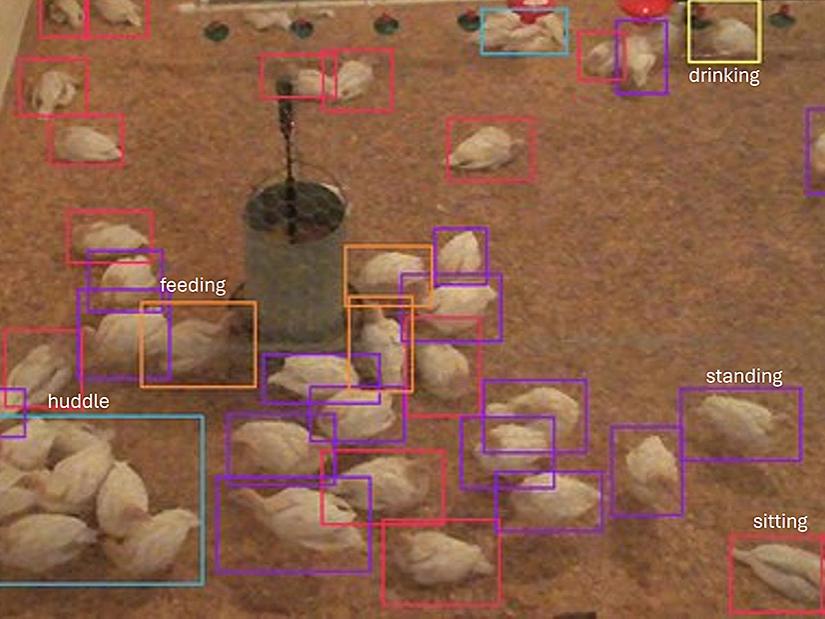
From the videos, the researchers took individual image frames and manually labeled the turkeys’ behaviors, including feeding, drinking, sitting, standing, perching, huddling and wing flapping. Credit: Penn State. Creative Commons
<関連情報>
- https://www.psu.edu/news/research/story/its-bird-its-drone-its-both-ai-tech-monitors-turkey-behavior
- https://www.sciencedirect.com/science/article/pii/S0032579125013434
無人航空機とコンピュータービジョンを用いた七面鳥の行動の空中監視 Aerial monitoring of turkey behavior using unmanned aerial vehicles and computer vision
Giulio Calderone, Mireia Molins, Pietro Catania, John Boney, Enrico Casella
Poultry Science Available online: 11 November 2025
DOI:https://doi.org/10.1016/j.psj.2025.106103
Abstract
Monitoring animal health and welfare in large commercial poultry houses is an essential aspect of management and productivity, but it is a time-consuming and labor-intensive task. Additionally, high employee turnover increases training costs and compromises effective and efficient operations. To address these challenges, this study explores the combined use of an Unmanned Aerial Vehicle (UAV) and computer vision technology as an innovative, non-invasive approach to support continuous behavioral monitoring and staff workload. Using a DJI Neo UAV equipped with a color camera, overhead videos of 160 Nicholas Select turkey toms from age 5 d to 32 d were acquired. Video frames were sampled and manually annotated to create a dataset for a You Only Look Once (YOLO) computer vision model capable of detecting and classifying eight key behaviors: feeding, drinking, sitting, standing, perching, huddling, wing flapping, and dead. The annotated dataset of 2388 images was divided into 70 % training, 15 % validation and 15 % testing. Among the tested configurations, the best model was selected based on the Mean Average Precision 50–95 (mAP50-95) performance on the validation set, corresponding to version 11 of the large YOLO model (YOLOv11-l) with an image resolution of 1280 pixels per side. Performance metrics for this model on the independent testing set were: precision = 0.90, recall = 0.87, F1-score = 0.89, and Mean Average Precision 50 (mAP50) = 0.89 using confidence threshold of 0.20. These results suggest that UAV-integrated computer vision could be applied to accurately classify turkey behaviors in commercial environments, improving welfare monitoring and management efficiency.


