2025-11-19 ワシントン州立大学 (WSU)
<関連情報>
- https://news.wsu.edu/press-release/2025/11/19/study-questions-water-safety-beliefs/
- https://iwaponline.com/jwh/article/23/9/1042/109398/Comparing-cultural-perceptions-of-drinking-water
グアテマラの都市部と農村部のコミュニティにおける飲料水の安全性と水質に関する文化的認識の比較 Comparing cultural perceptions of drinking water safety with water quality in urban and rural Guatemalan communities
Brooke M. Ramay;Carmen Castillo;Paulina Garzaro;Natalie Fahsen;Lucas Santos;Andrea Gomez;Juan Carlos Romero;Joyce Lu;Celia Cordón-Rosales;Douglas R. Call;…
Journal of water & Health Published:September 06 2025
DOI:https://doi.org/10.2166/wh.2025.056
ABSTRACT
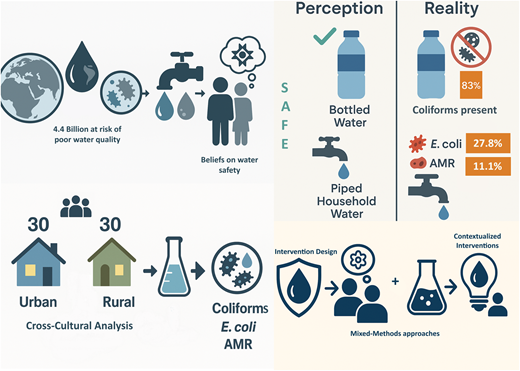 Access to safe drinking water remains a major public health challenge in low- and middle-income countries (LMICs), with 4.4 billion people lacking safely managed sources. Contaminated water contributes to infectious diseases and antimicrobial resistance, increasing morbidity and mortality. While interventions guided by the WHO/UNICEF Joint Monitoring Programme (JMP) aim to improve water access, sociocultural factors influencing water use are likely to play a critical role in developing effective interventions. To assess how sociocultural factors can inform water safety interventions, this study combines cultural consensus analysis of drinking water quality with microbiological assessments of water quality in 30 urban and 30 rural households in Quetzaltenango. Water samples were tested for coliforms, Escherichia coli, and antimicrobial-resistant Enterobacterales. Participants ranked bottled water as the safest source, yet laboratory analysis revealed bottled water had the highest coliform contamination (83.3%). Piped household water, another highly ranked source, exhibited high E. coli contamination (27.8%), presence of extended-spectrum beta-lactamase (ESBL) Enterobacterales (11.1%), and presence of carbapenem-resistant Enterobacterales (11.1%). While JMP guidelines are essential for water safety assessments, sociocultural perceptions play a crucial role in shaping water consumption behaviors. Integrating ethnographic methods with water quality assessments can lead to the design of more nuanced water safety interventions.