2025-11-07 広島大学
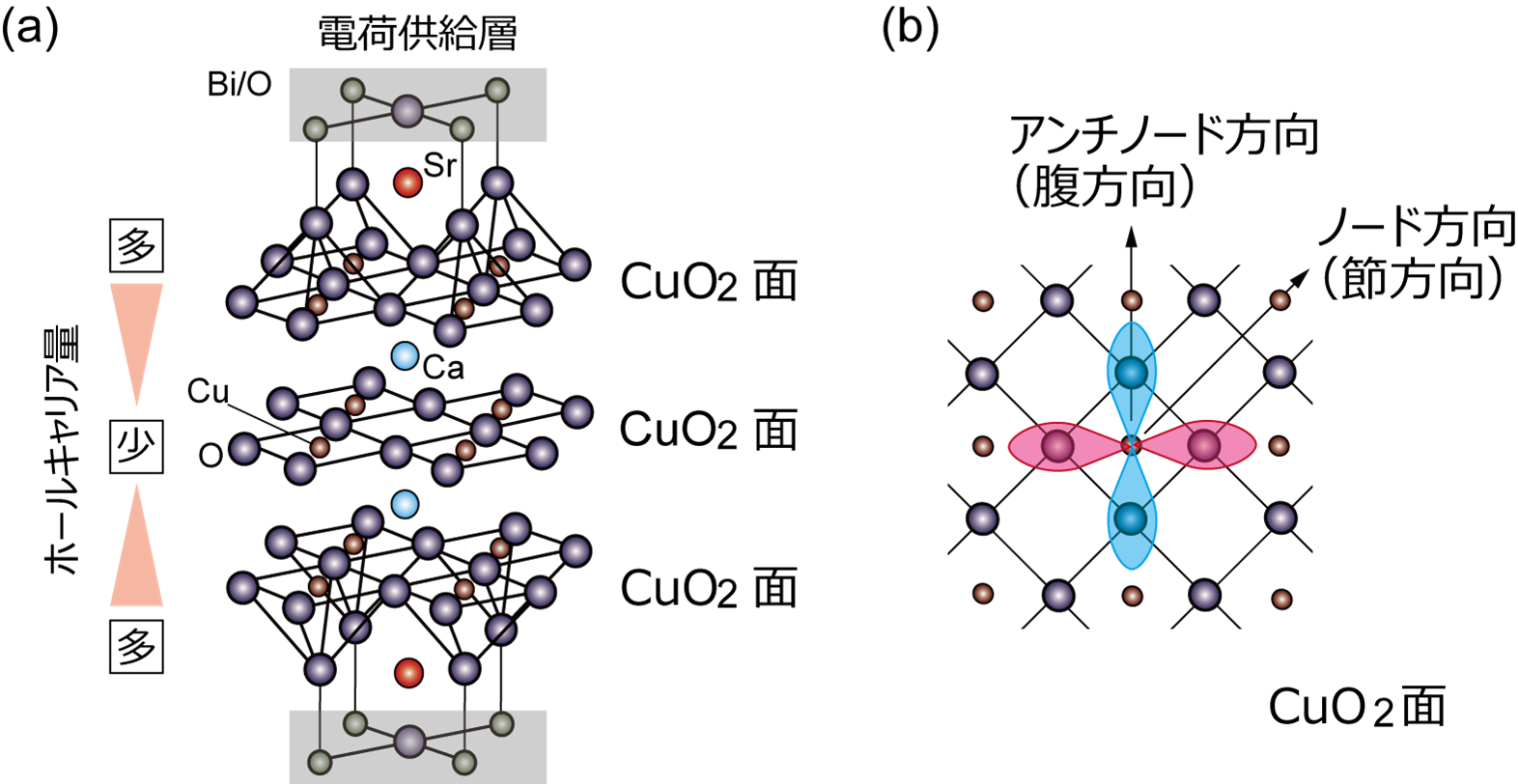
図1: 3枚の超伝導層(CuO2面)をもつ三層系銅酸化物高温超伝導体の結晶構造。
<関連情報>
- https://www.hiroshima-u.ac.jp/news/93880
- https://www.hiroshima-u.ac.jp/system/files/274708/【プレスリリース】銅酸化物の高温超伝導体で特殊な電子状態「ノード金属」を発見%20~三層構造が高い超伝導を実現する仕組みの解明へ~.pdf
- https://www.nature.com/articles/s41467-025-64492-x
三層銅酸化物における極端にドープされていないCuO 2面における近接誘起ノード金属 Proximity-induced nodal metal in an extremely underdoped CuO2 plane in triple-layer cuprates
Shin-ichiro Ideta,Shintaro Adachi,Takashi Noji,Shunpei Yamaguchi,Nae Sasaki,Shigeyuki Ishida,Shin-ichi Uchida,Takenori Fujii,Takao Watanabe,Wen O. Wang,Brian Moritz,Thomas P. Devereaux,Masashi Arita,Chung-Yu Mou,Teppei Yoshida,Kiyohisa Tanaka,Ting-Kuo Lee & Atsushi Fujimori
Nature Communications Published:27 October 2025
DOI:https://doi.org/10.1038/s41467-025-64492-x
Abstract
We performed angle-resolved photoemission spectroscopy studies on the triple-layer Bi2Sr2Ca2Cu3O10+δ over a wide doping range. Although the doping level of the inner CuO2 plane is extremely low in underdoped samples, the d-wave SC gap is enhanced to the unprecedentedly large value of Δ0 ~ 80–100 meV at the antinode. This gap persists well above Tc without a Fermi arc, indicating a “nodal metal”. We attribute the nodal metallic behavior to the unique local environment of the inner clean CuO2 plane, sandwiched by nearly optimally-doped two outer planes and hence subject to strong proximity effect from both sides. In the nodal metal, quasiparticle peaks show electron-hole symmetry, suggesting d-wave pairing fluctuations. Thus the proximity effect on the innermost CuO2 plane is the strongest in the triple-layer cuprates, which explains why the Tc reaches the maximum at the layer number of three in every multi-layer cuprate family.