2025-11-05 国立極地研究所,北海道大学,北見工業大学
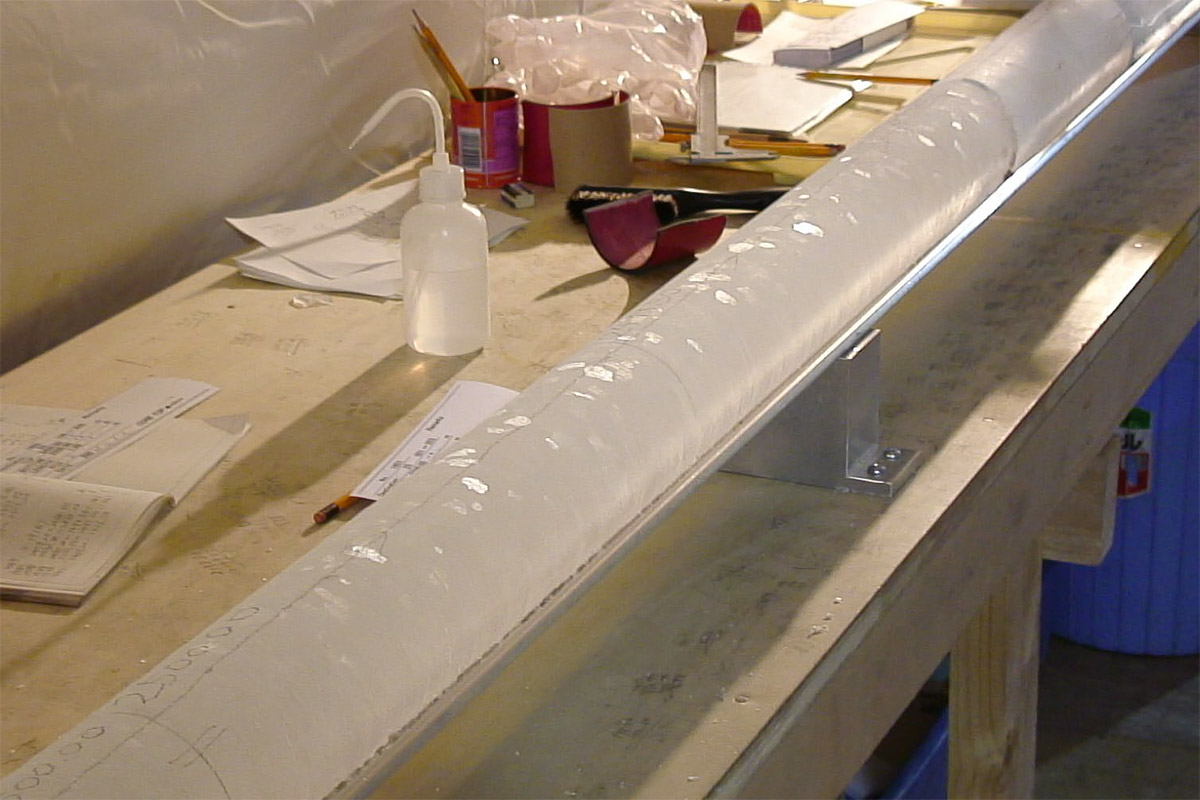
ドームふじ氷床コア深部(深度2,500m付近)のアイスコアの写真。直径94mmの円柱状の氷の表面に、光の反射の異なる多数の領域がパッチ状に浮き出ている。この不均一な光の反射の特徴は、このアイスコアが多数の異なる配列方位をもつような結晶粒からなる「多結晶構造」をもつことを反映している。本研究では氷床の最も深い約20%に相当する深度領域について、多結晶のもつ結晶配列の特徴と微細構造を明らかにした。(国立極地研究所 藤田秀二 撮影)
<関連情報>
南極ドームふじ氷床コア深部における結晶配向ファブリックの発達と変動:不純物粒子と移動を伴う再結晶化の影響 Development and fluctuation of crystal orientation fabric in the deep sections of the Dome Fuji ice core, Antarctica: impacts of dust particles and migration recrystallization
Tomotaka Saruya, Atsushi Miyamoto, Shuji Fujita, Kumiko Goto-Azuma, Motohiro Hirabayashi, Akira Hori, Makoto Igarashi, Yoshinori Iizuka, Takao Kameda, Hiroshi Ohno, Wataru Shigeyama, and Shun Tsutaki
The Cryosphere Published:03 Jul 2025
DOI:https://doi.org/10.5194/tc-19-2365-2025
Abstract
This study investigated the crystalline textural properties of an Antarctic deep ice core with a length of 3035 m acquired from an inland plateau dome, with a focus on depths below 2400 m. The cluster strength of the c axes was ascertained using the dielectric tensor method to assess the bulk properties of thick sections, and detailed orientation distributions of the c and a axes were determined using the Laue X-ray diffraction technique. The c– and a-axis fabric data were compared with various other characteristics of the same ice core. Microstructural observations were made using optical microscopy. The clustering strength of the single-pole c-axis fabric was at a maximum at depths between 2400 and 2640 m. The relationship between the cluster strength and the concentration of dusty impurities was found to change at approximately 2640 m, and fluctuations in strength increased significantly below this depth. Impurity-rich layers maintained a high degree of clustering, whereas layers with fewer impurities showed relaxation. The latter layers also exhibited evidence of nucleation and grain boundary migration. In ice such as this, the degree of a-axis organization was increased with one or two sets of three preferred orientations. Dynamic recrystallization evidently played a critical role, with more pronounced effects in impurity-poor layers than in impurity-rich layers. This phenomenon promoted the relaxation of the c-axis clustering, deformation based on dislocation creep and organization of the a axis. Below 2580 m, the angles of inclination of the c-axis cluster and layers deviated significantly from the vertical, suggesting that the system rotated as a rigid body as a result of simple shear.