
2025-10-29 スウェーデン王立工科大学(KTH)
<関連情報>
- https://www.kth.se/en/om/nyheter/centrala-nyheter/tveksam-klimatnytta-med-algfoder-1.1435150
- https://www.nature.com/articles/s41598-025-18322-1
食肉・乳製品生産における気候変動対策としての海藻:LCAの視点 Seaweed as a climate fix for meat and dairy production: an LCA perspective
J.-B. E. Thomas,V. W. Xu,S. J. Krizsan,I. M. Aasen,A. Oliveira,H. Ramos,P. Tyedmers,M. Hayes & F. Gröndahl
Scientific Reports Published:18 September 2025
DOI:https://doi.org/10.1038/s41598-025-18322-1
Abstract
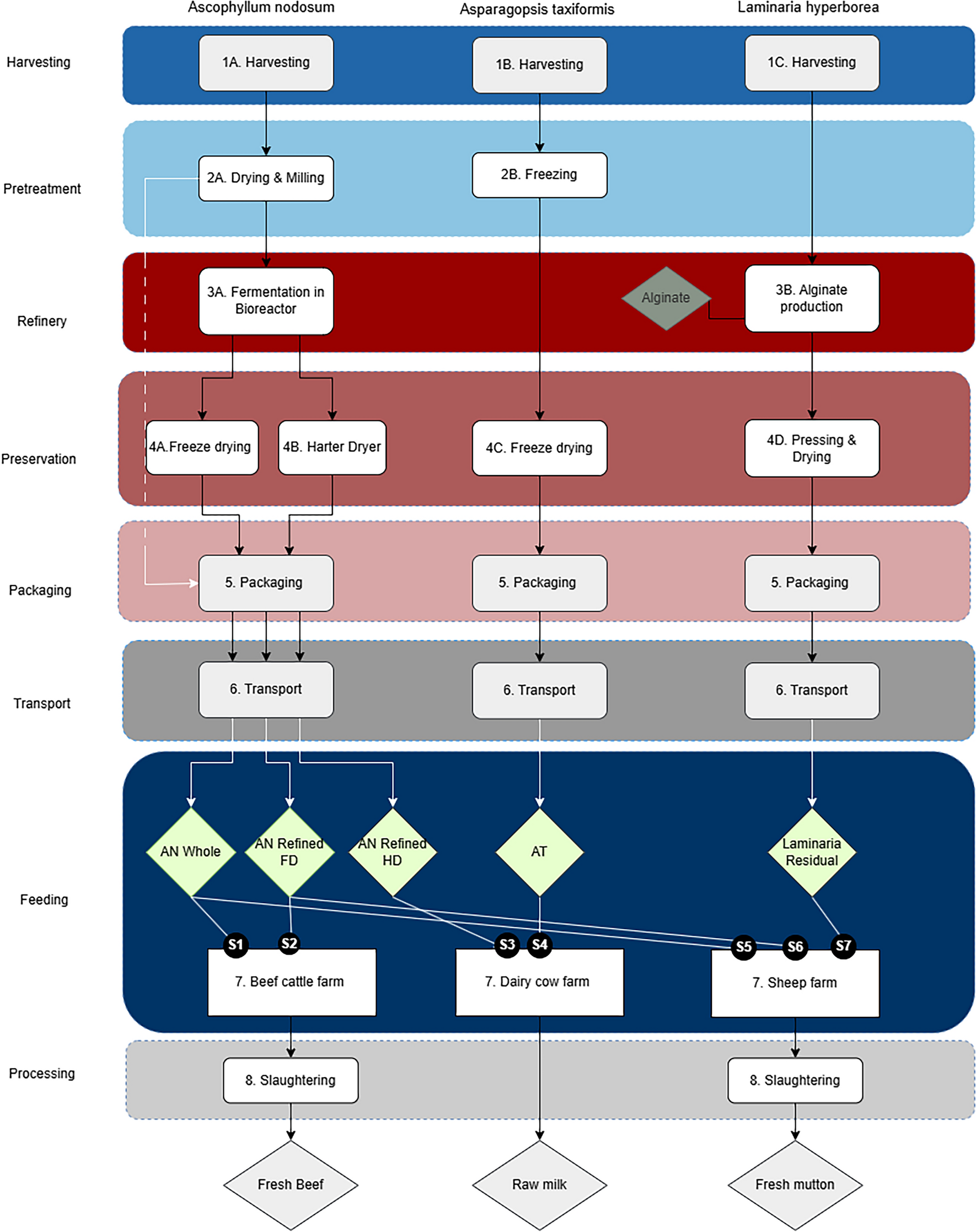
Livestock supply chains contribute a substantial share of global anthropogenic greenhouse gas (GHG) emissions, with enteric methane (CH₄) from ruminants being a key driver. Seaweed-derived feed additives have been proposed as a CH₄ mitigation strategy, but their broader environmental trade-offs remain unclear. This study applies life cycle assessment (LCA) to evaluate seven seaweed-supplemented scenarios across beef, dairy, and sheep production, assessing climate change, marine and freshwater eutrophication, land use, fossil fuel depletion, and water use. Results indicate that while certain seaweed additives can lower CH₄ emissions in vitro, real-world reductions in total GHG emissions remain modest. Energy-intensive processing and long transport distances can offset CH₄ abatement gains, with only scenarios utilizing low-impact by-products achieving net climate benefits. Sensitivity analyses highlight the importance of Global Warming Potential (GWP) time horizon selection, energy sources, and grazing practices in determining overall environmental performance. Optimizing algae sourcing, processing, and application will be essential to realizing meaningful and scalable mitigation potential in ruminant systems. While seaweed additives can contribute to CH₄ reduction, this study concludes they will not single-handedly deliver transformative climate benefits.


