2025-09-12 チャルマース工科大学
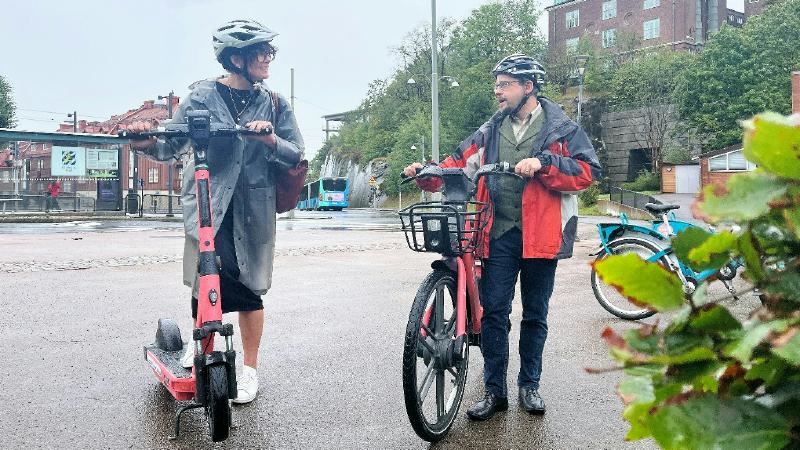
What’s best? For those who want to rent the safest vehicle, thus far the e-bicycle has seemed to be the best choice. But a recently published study from Chalmers University of Technology, which compared these alternatives in a more equitable way than previous research, has shown that this is not true – on the contrary, the e-scooter is safer according to the study’s results. Photo: Chalmers University of Technology, Mia Halleröd Palmgren.
<関連情報>
- https://news.cision.com/chalmers/r/rented-e-bicycles-more-dangerous-than-e-scooters-in-cities,c4233450
- https://www.sciencedirect.com/science/article/pii/S0022437525000878
電動自転車は電動スクーターより安全か? 車両タイプ・場所・曝露量・使用頻度・所有形態を調整した欧州域内の負傷リスク比較 Is e-cycling safer than e-scootering? Comparing injury risk across Europe when vehicle-type, location, exposure, usage, and ownership are controlled
Rahul Rajendra Pai, Marco Dozza
Journal of Safety Research Available online: 18 June 2025
DOI:https://doi.org/10.1016/j.jsr.2025.06.015
Highlights
- E-cyclists crashes were compared to e-scooterists crashes in 7 European cities.
- For the first time, location, exposure, usage, and ownership were controlled for.
- E-scooters had lower crash rates than e-bicycles in most cities.
- High-resolution GPS data and geofencing enable precise exposure measurement.
- E-scootering may be not riskier than cycling as previously reported.
Abstract
Introduction: Recently, e-scooters have proliferated worldwide. Municipalities have been struggling with regulating e-scooters due to public concerns that the injuries from the new crashes outweigh the health and environmental benefits of micromobility use. Indeed, several studies have reported crash risk for e-scooters 4 to 10 times higher than that for bicycles. Method: We had unprecedented access to crash and exposure data collected in 2022 and 2023 from a rental service of e-scooters and e-bicycles in seven European cities. We conducted a retrospective cross-sectional study to compute injury rates and incidence-rate ratios for each city while directly controlling for geography, ownership, and exposure (measured in three different ways). Results: We analyzed 686 e-scooterist and 35 e-cyclist crashes. Injury rates were higher for e-cyclists than e-scooterists in most of the cities, for all exposure measures. Further, the incidence-rate ratios indicate that the injury risk was 2.5–10 times lower for e-scootering than e-cycling. Conclusions: E-scootering may not be riskier than cycling as several studies have claimed. In fact, by exploiting technology to control for location, exposure, ownership, and usage, our analysis shows that e-scooterists experience lower crash rates than e-cyclists. While our analysis has some limitations and cannot be considered conclusive evidence, taking location, usage, ownership, and high-resolution exposure into account—which our analysis did contrary to previous studies—is crucial for a more accurate comparison among (micromobility) transport modes. In general, our research suggests incorporating geofencing and GPS-derived exposure metrics in future safety assessments. Practical application: The results and methodologies presented in this paper may help urban planning of rental micromobility services within cities.