
025-08-25 中国科学院(CAS)
<関連情報>
- https://english.cas.cn/newsroom/research_news/life/202508/t20250827_1051440.shtml
- https://www.nature.com/articles/s41522-025-00796-6
生物防除と植物成長におけるNocardiopsis alba B57の二重機能性:農業持続可能性へのメタボロミクスアプローチ Dual-functionality of Nocardiopsis alba B57 in biocontrol and plant growth: a metabolomic approach to agricultural sustainability
Osama Abdalla Abdelshafy Mohamad,Yong-Hong Liu,Tamer Elsamahy,Shuai Li,Rajivgandhi Govindan,Nigora Kuchkarova,Shaimaa Hatab,Yuanming Zhang & Wen-Jun Li
npj Biofilms and Microbiomes Published:18 August 2025
DOI:https://doi.org/10.1038/s41522-025-00796-6
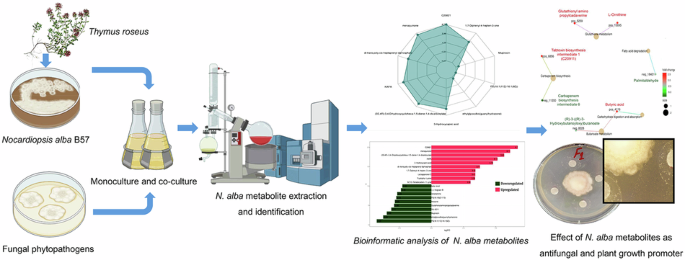
Abstract
The increasing incidence of fungal phytopathogens poses a significant challenge to agricultural sustainability, necessitating the development of environmental alternatives to synthetic fungicides and mitigating their ecological impact. This study explores the efficiency of Nocardiopsis alba B57 to produce secondary metabolites with antifungal and plant growth-promoting properties. Untargeted metabolomics using ultra-high-performance liquid chromatography (UPLC-MS/MS) and Kyoto Encyclopedia of Genes and Genomes (KEGG) pathway analyses identified key metabolites (e.g., carbapenem, menaquinone, and fumiquinazoline) in the co-culture environment with fungal pathogens. Additionally, principal component analysis and OPLS-DA differentiated monoculture and co-culture metabolic profiles, revealed carbapenem biosynthesis as a highly enriched pathway. The comprehensive metabolomics data and the statistical analysis of the identified metabolites confirmed that co-culturing of B57 and fungal strains showed upregulated metabolites (e.g., carbapenem and menaquinone). However, other metabolites (e.g., mupirocin) were downregulated and significantly suppressed. These changes in metabolic activity reflect the organism’s adaptive and competitive responses during the co-culture conditions with fungal pathogens and influence plant hormone signaling (e.g., auxin and cytokinin), promoting plant growth and disease resistance. These findings underscore B57’s adaptive biosynthetic response to co-culture conditions, supporting its use as a sustainable biocontrol agent and boosting crop productivity.


