
2025-08-07 アリゾナ大学
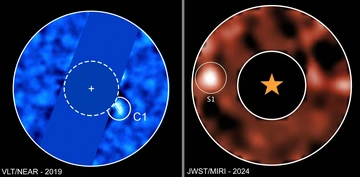
Left panel: The initial detection of a planet candidate (labeled C1) was made by Wagner and his team in 2019, using the Very Large Telescope operated by the European Southern Observatory in Chile. Right panel: In 2024, the James Webb’s Space Telescope’s Mid-Infrared Instrument, which uses a coronagraphic mask to block the bright glare from Alpha Centauri A, revealed a potential planet (labeled S1) on the other side of the star.
NASA, ESA, CSA, Aniket Sanghi (Caltech), Chas Beichman (NExScI, NASA/JPL-Caltech), Dimitri Mawet (Caltech), Joseph DePasquale (STScI), Wagner et al.
<関連情報>
- https://news.arizona.edu/news/alpha-centauri-suns-closest-stellar-neighbor-likely-harbors-giant-planet
- https://arxiv.org/abs/2508.03814
- https://www.nature.com/articles/s41467-021-21176-6
隣の宇宙:αケンタウリAの居住可能領域で観測された巨大惑星の候補。人工知能による観測、軌道と物理的特性、およびエクソゾディの上限値 Worlds Next Door: A Candidate Giant Planet Imaged in the Habitable Zone of α Cen A. I. Observations, Orbital and Physical Properties, and Exozodi Upper Limits
Charles Beichman, Aniket Sanghi, Dimitri Mawet, Pierre Kervella, Kevin Wagner, Billy Quarles, Jack J. Lissauer, Max Sommer, Mark Wyatt, Nicolas Godoy, William O. Balmer, Laurent Pueyo, Jorge Llop-Sayson, Jonathan Aguilar, Rachel Akeson, Ruslan Belikov, Anthony Boccaletti, Elodie Choquet, Edward Fomalont, Thomas Henning, Dean Hines, Renyu Hu, Pierre-Olivier Lagage, Jarron Leisenring, James Mang, Michael Ressler, Eugene Serabyn, Pascal Tremblin, Marie Ygouf, Mantas Zilinskas
arXiv Submitted on 5 Aug 2025
DOI:https://doi.org/10.48550/arXiv.2508.03814
Abstract
We report on coronagraphic observations of the nearest solar-type star, α Cen A, using the MIRI instrument on the James Webb Space Telescope. The proximity of α Cen (1.33 pc) means that the star’s habitable zone is spatially resolved at mid-infrared wavelengths, so sufficiently large planets or quantities of exozodiacal dust would be detectable via direct imaging. With three epochs of observation (August 2024, February 2025, and April 2025), we achieve a sensitivity sufficient to detect Teff ≈ 225– 250 K (1–1.2 RJup) planets between 1′′–2′′ and exozodiacal dust emission at the level of >5–8× the brightness of our own zodiacal cloud. The lack of exozodiacal dust emission sets an unprecedented limit of a few times the brightness of our own zodiacal cloud—a factor of ≳ 5–10 more sensitive than measured toward any other stellar system to date. In August 2024, we detected a Fν(15.5 µm) = 3.5 mJy point source, called S1, at a separation of 1.5′′ from α Cen A at a contrast level of 5.5×10⁻⁵ . Because the August 2024 epoch had only one successful observation at a single roll angle, it is not possible to unambiguously confirm S1 as a bona fide planet. Our analysis confirms that S1 is neither a background nor a foreground object. S1 is not recovered in the February and April 2025 epochs. However, if S1 is the counterpart of the object, C1, seen by the VLT/NEAR program in 2019, we find that there is a 52% chance that the S1 + C1 candidate was missed in both follow-up JWST/MIRI observations due to orbital motion. Incorporating constraints from the non-detections, we obtain families of dynamically stable orbits for S1 + C1 with periods between 2–3 years. These suggest that the planet candidate is on an eccentric (e ≈ 0.4) orbit significantly inclined with respect to the α Cen AB orbital plane (imutual ≈ 50◦ , prograde, or ≈ 130◦ , retrograde). Based on the photometry and inferred orbital properties, the planet candidate could have a temperature of 225 K, a radius of ≈1–1.1 RJup and a mass between 90–150 MEarth, consistent with RV limits.
αケンタウリの居住可能領域内にある低質量惑星のイメージング Imaging low-mass planets within the habitable zone of α Centauri
K. Wagner,A. Boehle,P. Pathak,M. Kasper,R. Arsenault,G. Jakob,U. Käufl,S. Leveratto,A.-L. Maire,E. Pantin,R. Siebenmorgen,G. Zins,O. Absil,N. Ageorges,D. Apai,A. Carlotti,É. Choquet,C. Delacroix,K. Dohlen,P. Duhoux,P. Forsberg,E. Fuenteseca,S. Gutruf,O. Guyon,… T. de Zeeuw
Nature Communications Published:10 February 2021
DOI:https://doi.org/10.1038/s41467-021-21176-6
Abstract
Giant exoplanets on wide orbits have been directly imaged around young stars. If the thermal background in the mid-infrared can be mitigated, then exoplanets with lower masses can also be imaged. Here we present a ground-based mid-infrared observing approach that enables imaging low-mass temperate exoplanets around nearby stars, and in particular within the closest stellar system, α Centauri. Based on 75–80% of the best quality images from 100 h of cumulative observations, we demonstrate sensitivity to warm sub-Neptune-sized planets throughout much of the habitable zone of α Centauri A. This is an order of magnitude more sensitive than state-of-the-art exoplanet imaging mass detection limits. We also discuss a possible exoplanet or exozodiacal disk detection around α Centauri A. However, an instrumental artifact of unknown origin cannot be ruled out. These results demonstrate the feasibility of imaging rocky habitable-zone exoplanets with current and upcoming telescopes.


