
2025-07-25 京都大学
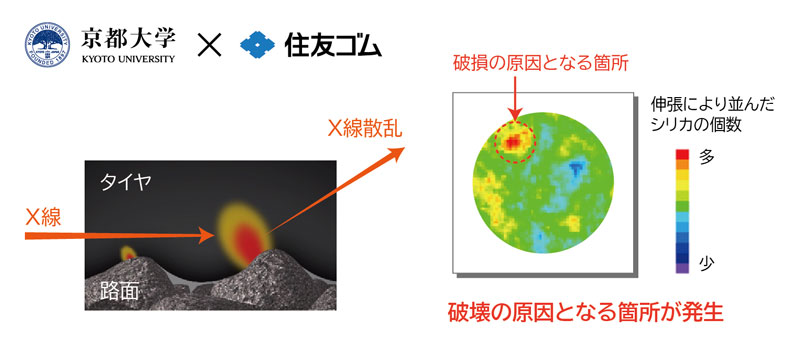 破壊に繋がるゴム内部構造の分布の違いを可視化
<関連情報>
- https://www.kyoto-u.ac.jp/ja/research-news/2025-07-25
- https://www.kyoto-u.ac.jp/sites/default/files/2025-07/web_250722_ogawa-3c05fa734a8086dcd23ae659c81d7e84.pdf
- https://onlinelibrary.wiley.com/doi/10.1002/sstr.202500257
ナノフィラーで強化されたゴムの破断前兆に関する新たな知見 New Insights into the Fracture Precursors of Rubber Reinforced with a Nanofiller
Hiroki Ogawa, Ryo Mashita, Hiroyuki Kishimoto, Shunsuke Ono, Wataru Yashiro, Taizo Kabe, Hiroyasu Masunaga, Mikihito Takenaka
Small Structures Published: 21 July 2025
DOI:https://doi.org/10.1002/sstr.202500257
Abstract
Filler-reinforced rubber materials are used in tires, belts, and other items indispensable to the daily lives of people. The characteristic required to realize a circular economy is an improved fracture resistance, i.e., a longer product lifetime. To improve the fracture resistance, understanding the fracture mechanism of materials is essential. Fracture results from the appearance of microscopic cavities, but the understanding of the heterogeneous structural deformation factors (fillers and molecular chains) responsible for cavities remains inadequate. Herein, the first capture of fracture precursor phenomena using simultaneous X-ray scattering/absorption–computed tomography measurements is reported. As precursor phenomena, deformation induces a grain structure in which each grain has different alignment of silica particles and orientation of molecular chains, and exfoliation of molecular chains from the silica particle surface occurs between the grains. Capturing the precursor phenomena from the heterogeneity perspective provides new insight into the design of materials.


