2025-07-23 東京科学大学
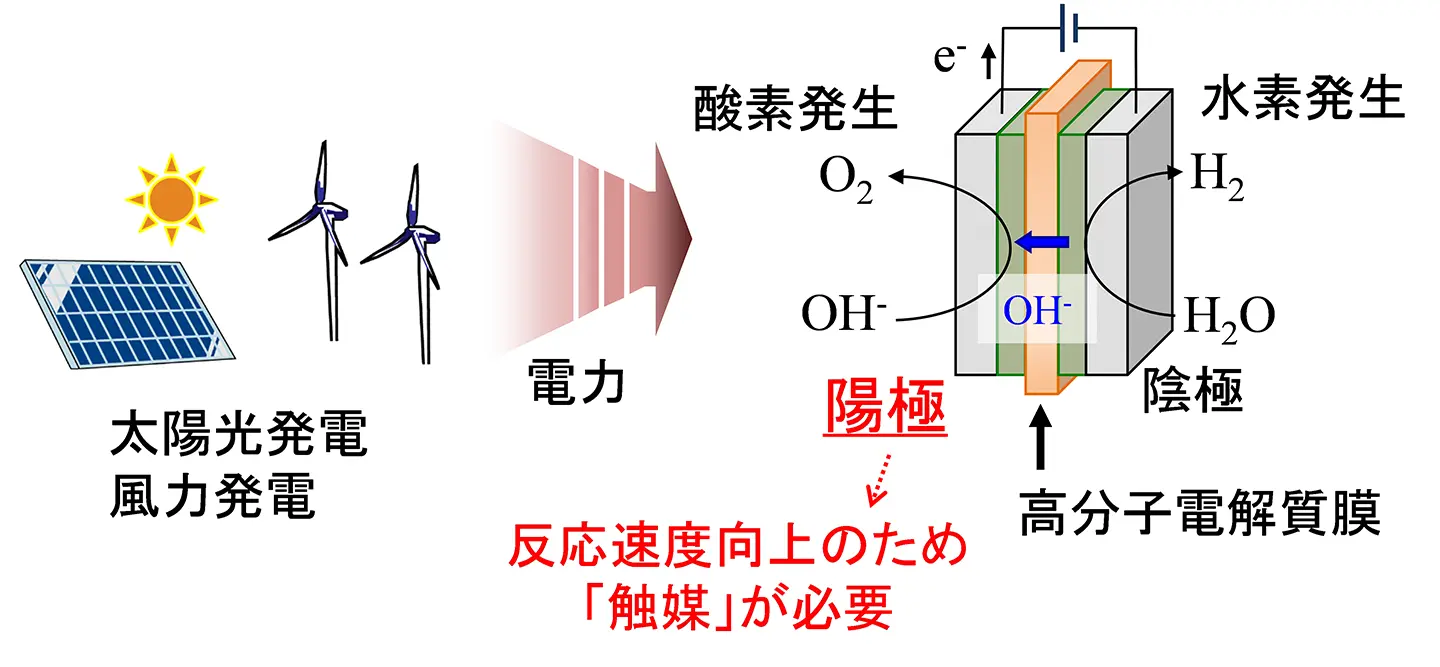
図1. OH−が伝導する高分子膜を電解質とした「アニオン交換膜型水電解」の概略
<関連情報>
- https://www.isct.ac.jp/ja/news/r90tcotf38x5
- https://www.isct.ac.jp/plugins/cms/component_download_file.php?type=2&pageId=&contentsId=1&contentsDataId=1909&prevId=&key=d630c426c44ea92f5c27a2f5c5e3cc09.pdf
- https://pubs.rsc.org/en/content/articlelanding/2025/cy/d5cy00200a
金属硫化物の電気化学的酸素発生触媒反応:電子効果の系統的研究 Electrochemical oxygen evolution catalysis of metal sulfides: a systematic study of electronic effects
Yuuki Sugawara, Taisei Uchiyama, Maxim Shishkin and Takeo Yamaguchi
Catalysis Science & Technology Published:22 Jul 2025
DOI:https://doi.org/10.1039/D5CY00200A
Abstract
Metal sulfides have various applications, and their unique electrochemical properties have elicited avenues for their use as electrocatalysts. Metal sulfides have demonstrated promising electrocatalytic activity for the anodic oxygen evolution reaction (OER) in water electrolysis. However, activity descriptors for the OER on metal sulfides have not yet been explored. In this study, we systematically investigate the electrocatalytic OER activities of metal sulfides and propose comprehensive OER descriptors. We select nine metal sulfides, namely, MnS, CoS2, NiS, CuS, Cu2S, MoS2, ZnS, NiCo2S4 and CoNi2S4, and evaluate their OER activities as well as analyze important factors in their OER catalysis. The metal sulfides exhibit distinct OER activities based on their metallic components. Further, density functional theory calculations show a strong correlation between their OER activities and unoccupied d-band centers, similar to the case of metal oxides. Additionally, the OER activities follow a volcano plot relationship with the number of d electrons, a novel finding in this field. These insights offer a rational design guideline for developing metal sulfide-based OER electrocatalysts and contribute to advancements in green hydrogen production.