2025-06-17 カリフォルニア大学アーバイン校(UCI)
<関連情報>
- https://news.uci.edu/2025/06/17/researchers-create-method-for-converting-urine-into-high-value-bio-implant-material/
- https://www.nature.com/articles/s41467-025-59416-8
ハイドロキシアパタイト製造のための合成骨酵母プラットフォームが可能にする費用対効果の高い尿リサイクル Cost-effective urine recycling enabled by a synthetic osteoyeast platform for production of hydroxyapatite
Isaak E. Müller,Alex Y. W. Lin,Yusuke Otani,Xinyi Zhang,Zong-Yen Wu,David Kisailus,Nigel J. Mouncey,Jeremy S. Guest,Behzad Rad,Peter Ercius & Yasuo Yoshikuni
Nature Communications Published:06 May 2025
DOI:https://doi.org/10.1038/s41467-025-59416-8
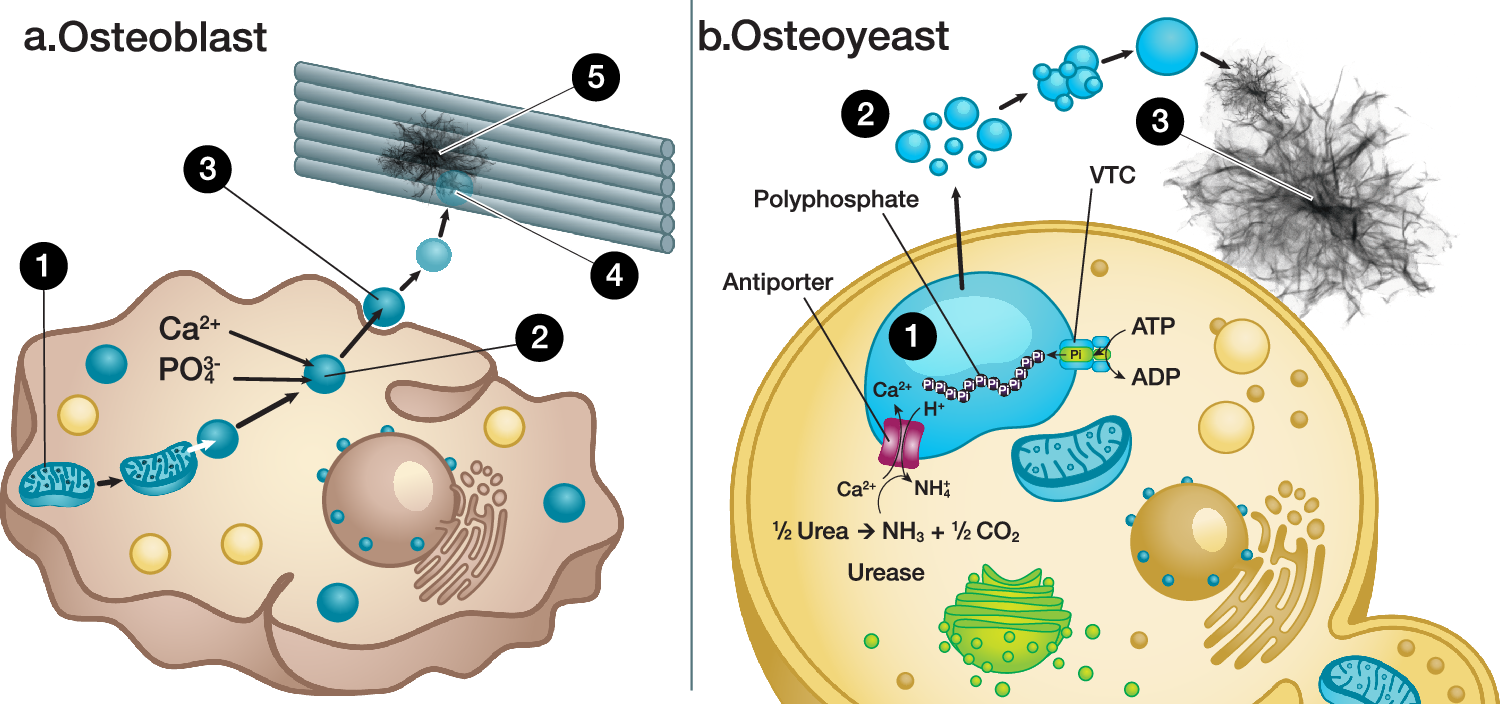
Abstract
Recycling human urine offers a sustainable solution to environmental challenges posed by conventional wastewater treatment. While it is possible to recover nutrients like nitrogen and phosphorus from urine, the low economic value of these products limits large-scale adoption. Here, we show that engineered yeast can convert urine into hydroxyapatite (HAp), a high-value biomaterial widely used in bone and dental applications. Inspired by the biological mechanisms of bone-forming cells, we develop a synthetic yeast platform osteoyeast, which uses enzymes to break down urea and increase the pH of the surrounding environment. This triggers the yeast vacuoles to accumulate calcium and phosphate as amorphous calcium phosphate, which is then secreted in vesicles and crystallized into HAp. We achieve HAp production at titers exceeding 1 g/L directly from urine. Techno-economic analysis demonstrates that this process offers clear economic and environmental advantages, making it a compelling strategy for high-value resource recovery from human waste.