

2026-11-13 核融合科学研究所
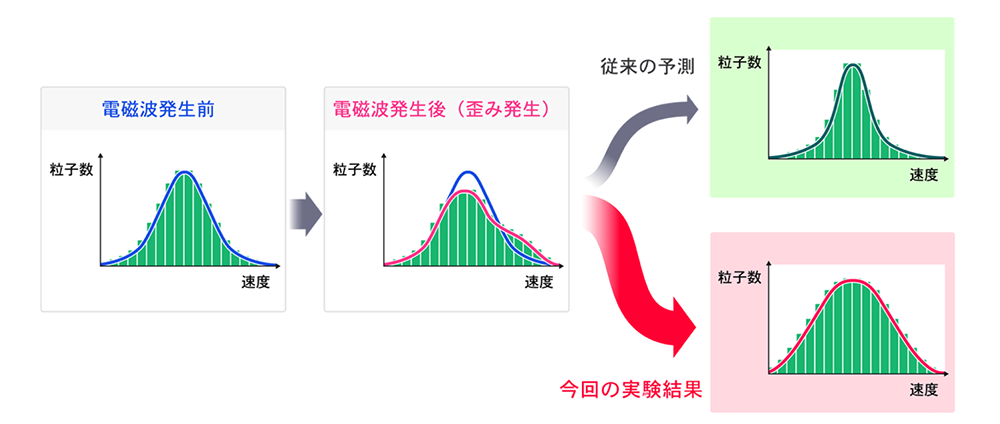
図 不安定なプラズマが電磁波を発生させて速度分布の歪みを引き起こし、その歪みが取れた時に粒子の動きの広がりが大きくなっている様子
<関連情報>
エネルギー粒子駆動型MHDバーストに伴う位相空間ダイナミクスの直接観測(Direct observation of phase-space dynamics during energetic-particle-driven MHD bursts)
Katsumi Ida, Mikirou Yoshinuma, Tatsuya Kobayashi, Kenichi Nagaoka, Kunihiro Ogawa, Tokihiko Tokuzawa, Hideo Nuga, Yuto Katoh
Communications Physics, 9, Article 345 (2026) 2026-11-10
DOI:10.1038/s42005-026-02939-3
核融合プラズマの加熱効率を高めるには、磁場中のイオンがどのようにエネルギーを獲得し、プラズマ内部へ輸送されるかを理解することが重要である。本研究では、大型ヘリカル装置(LHD)を用いて、高エネルギー粒子によって引き起こされる磁気流体力学(MHD)バースト発生時のイオンの位相空間ダイナミクスを直接観測した。時間分解能10 kHzの高速荷電交換分光法により、約150回のMHDバーストを解析した結果、発生から0.1ミリ秒以内に、磁場に平行な方向のイオン速度分布が変形し、バースト発生領域でイオンの平行エネルギーが約30%増加することを確認した。この現象はランダウ減衰や通過時間減衰による波動・粒子相互作用、および磁気リコネクションによる粒子加速と関連していた。その後、速度分布の異方性はイオン間衝突によって2~3ミリ秒で解消する一方、周辺部で増加したイオンエネルギーは中心部にも伝わり、特にランダウ減衰が生じる条件では中心部の加熱が長時間持続した。従来の熱拡散モデルでは説明が難しい高速なエネルギー輸送を示す成果であり、核融合プラズマの加熱機構と燃焼プラズマの性能向上に新たな知見を提供する。
Understanding how ions acquire energy and transport it within magnetically confined plasmas is essential for improving fusion heating efficiency. In this study, researchers directly observed ion phase-space dynamics during energetic-particle-driven magnetohydrodynamic (MHD) bursts using the Large Helical Device (LHD). By employing fast charge-exchange spectroscopy with a temporal resolution of 10 kHz and analyzing approximately 150 MHD burst events, they found that the ion velocity distribution parallel to the magnetic field became distorted within 0.1 milliseconds after burst onset, accompanied by an approximately 30% increase in parallel ion energy at the burst location. These changes were associated with wave-particle interactions, including Landau and transit-time damping, as well as particle acceleration potentially involving magnetic reconnection. Although the velocity-space anisotropy disappeared within 2–3 milliseconds through ion-ion collisions, the increased ion energy was subsequently transported toward the plasma core. In particular, core ion heating persisted longer under conditions involving Landau damping. These observations reveal rapid energy transport that cannot readily be explained by conventional thermal diffusion models, providing new insights into plasma heating mechanisms and the development of high-performance burning fusion plasmas.
