

2026-09-10 米国国立標準技術研究所(NIST)
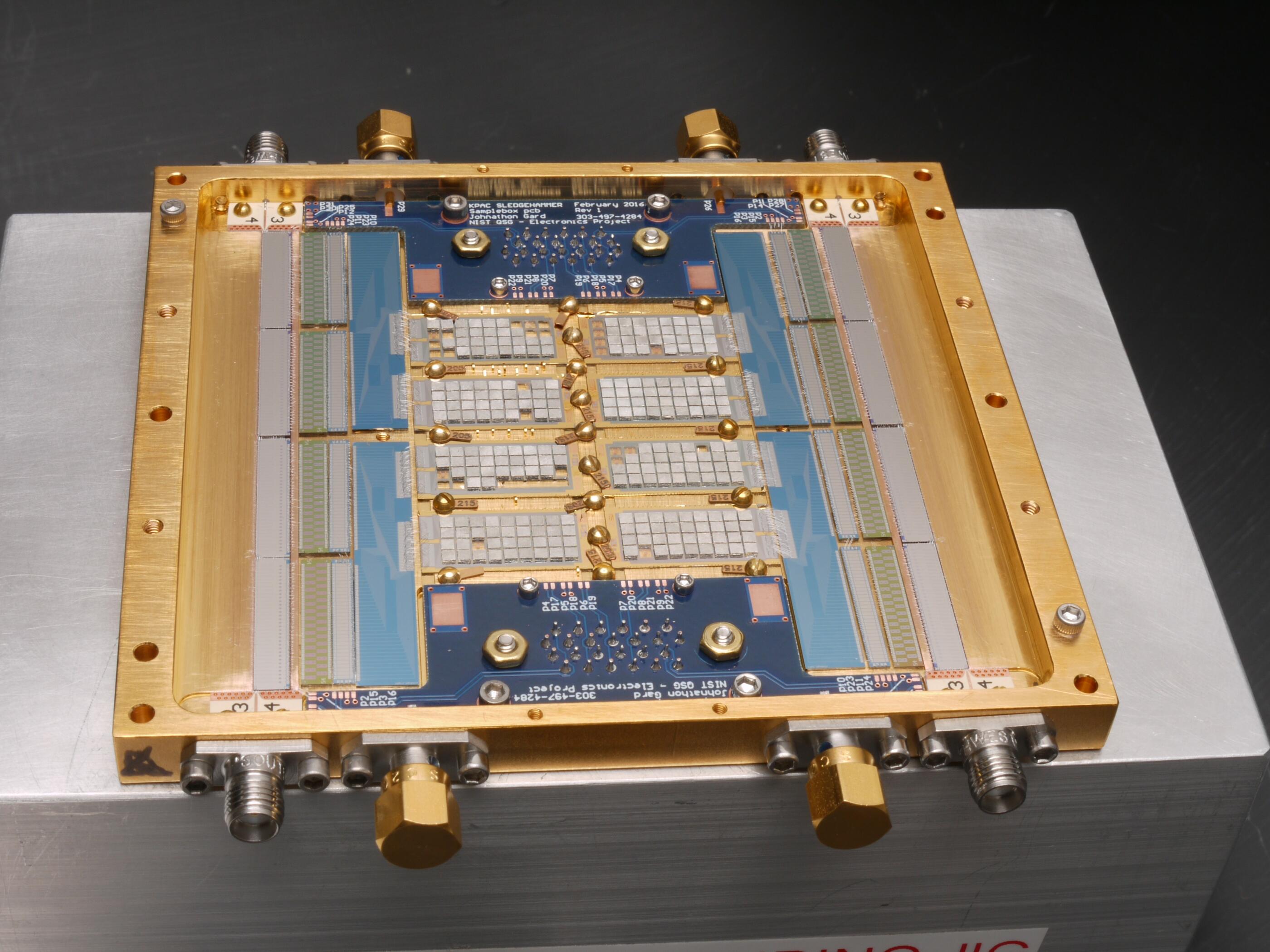
Image shows an array of about 250 gamma-ray transition edge sensors developed at NIST and used in the new study. Credit: NIST
<関連情報>
- https://www.nist.gov/news-events/news/2026/09/nist-developed-quantum-sensors-improve-nuclear-monitoring
- https://journals.aps.org/prl/abstract/10.1103/tcbz-kqk1
測定値と理論値KU、Np、PuのX線放出線幅 Measured and Theoretical K X-Ray Emission Linewidths of U, Np, and Pu
Abigail Wessels, Jonathan W. Dean, Daniel T. Becker, Douglas A. Bennett, Matthew H. Carpenter, Mark Croce, Joseph W. Fowler, Johnathon D. Gard, Paul Indelicato
Physical Review Letters Published: 10 September, 2026
DOI: https://doi.org/10.1103/tcbz-kqk1
Abstract
We present measurements of the K1 and K2 natural x-ray linewidths of uranium, neptunium, and plutonium (Z=92, 93, 94) obtained using a superconducting transition-edge sensor microcalorimeter array. The relative uncertainties range from 0.5% to 1.5%, improving upon previous values by factors ranging from 3 to 8. These refined linewidths reduce systematic errors in gamma-ray spectroscopy assays of Pu-bearing materials, where K x-rays overlap with diagnostic gamma lines. We also present multiconfiguration Dirac-Fock calculations of the K linewidths for U, Np, and Pu, providing a benchmark for theory and experiment. These calculations reveal a discrepancy between ab initio theory and experiment possible to observe only with the improved experimental accuracy achieved in this work.

