
2026-07-27 ミシガン大学
<関連情報>
- https://news.umich.edu/mercury-has-part-time-radiation-belts/
- https://www.nature.com/articles/s41550-026-02925-3
太陽風の駆動によって制御される水星の動的な電子放射線帯 Dynamic electron radiation belt at Mercury controlled by solar wind driving
Jiutong Zhao (赵 玖桐),Ryan M. Dewey,Weijie Sun (孙 为杰),James A. Slavin,Paul S. Szabo,Lucas Liuzzo,Nicolas André & Mathias Rojo
Nature Astronomy Published:27 July 2026
DOI:https://doi.org/10.1038/s41550-026-02925-3
Abstract
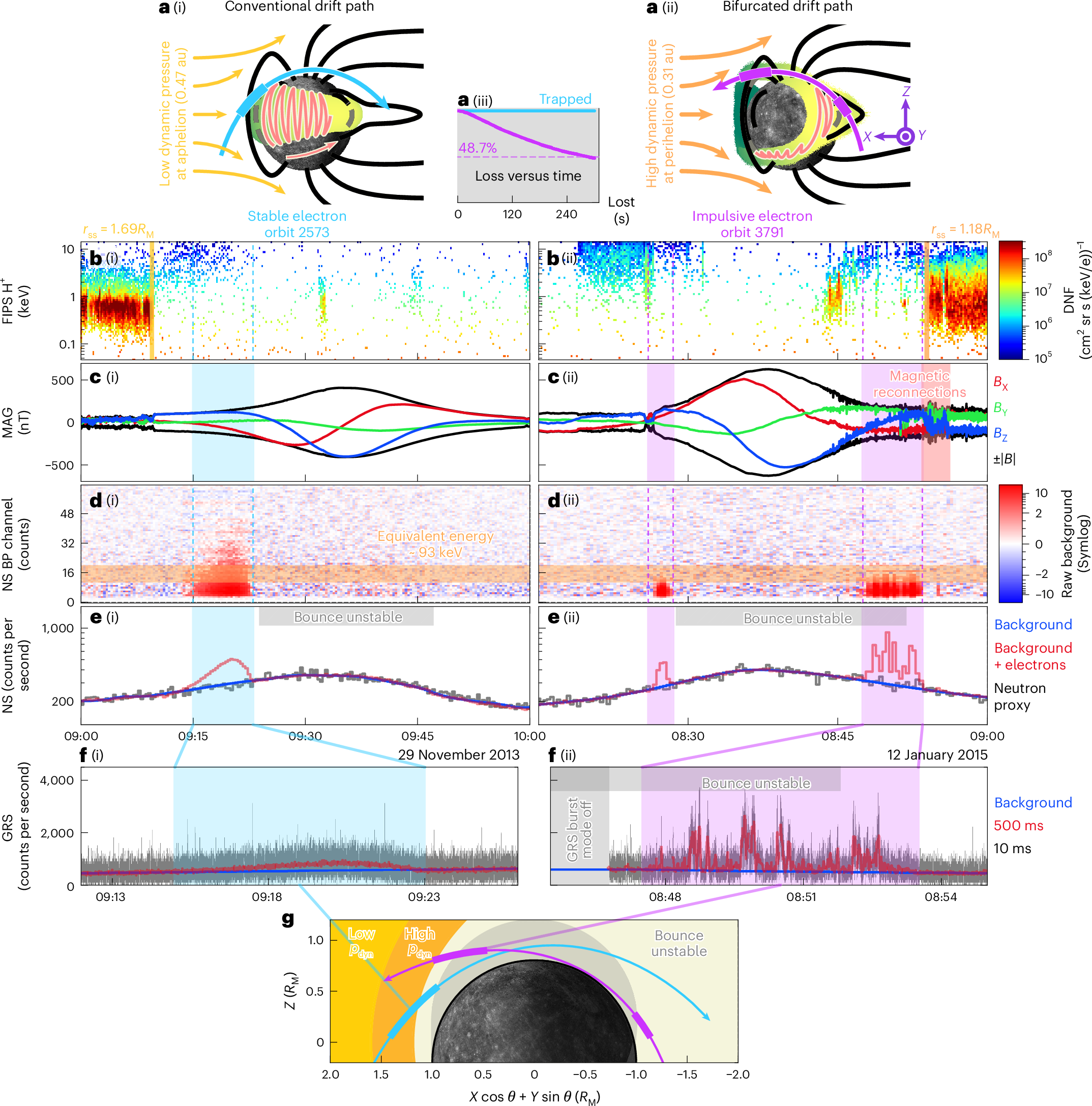
Electron radiation belts, reservoirs of stably trapped energetic electrons hazardous to space technology, are a prevalent feature of most magnetized planetary environments. However, their existence in the compact magnetosphere of Mercury has been a subject of debate for decades. The presence of energetic electrons was first identified by Mariner 10’s observations in the 1970s but was subsequently questioned by MESSENGER’s limited energetic particle measurements 40 years later. Here we integrate MESSENGER’s more sensitive indirect energetic electron measurements with new analysis techniques, particle simulations and theory to discover a structured radiation belt with a variable morphology subject to solar wind activity. This radiation belt can persist for several Earth days and, thus, seems to be quasi-permanent under weak solar wind forcing. However, it becomes unstable under strong driving as electron drift orbits bifurcate about the magnetic equator within the dayside magnetosphere and particles are rapidly lost. Our results establish that even compact magnetospheres can host radiation belts and, furthermore, that Mercury is a natural laboratory for radiation-belt physics usually inaccessible at Earth: one of an extreme, rapidly driven state.

