2026-07-27 中国科学院(CAS)
<関連情報>
- https://english.cas.cn/newsroom/cas-in-media/202607/t20260727_1179182.shtml
- https://essd.copernicus.org/articles/18/4943/2026/
第三極上空における水銀環境データセット Mercury dataset over the Third Pole
Shichang Kang, Jie Huang, Qianggong Zhang, Junming Guo, Xiufeng Yin, Shiwei Sun, Xuejun Sun, Lekhendra Tripathee, Sabur Abdullaev, Wenjun Tang, Yi Zhang, Xiwen Miao, Liujian Liao, and Lusheng Che
Earth System Science Data Published:16 Jul 2026
DOI:https://doi.org/10.5194/essd-18-4943-2026
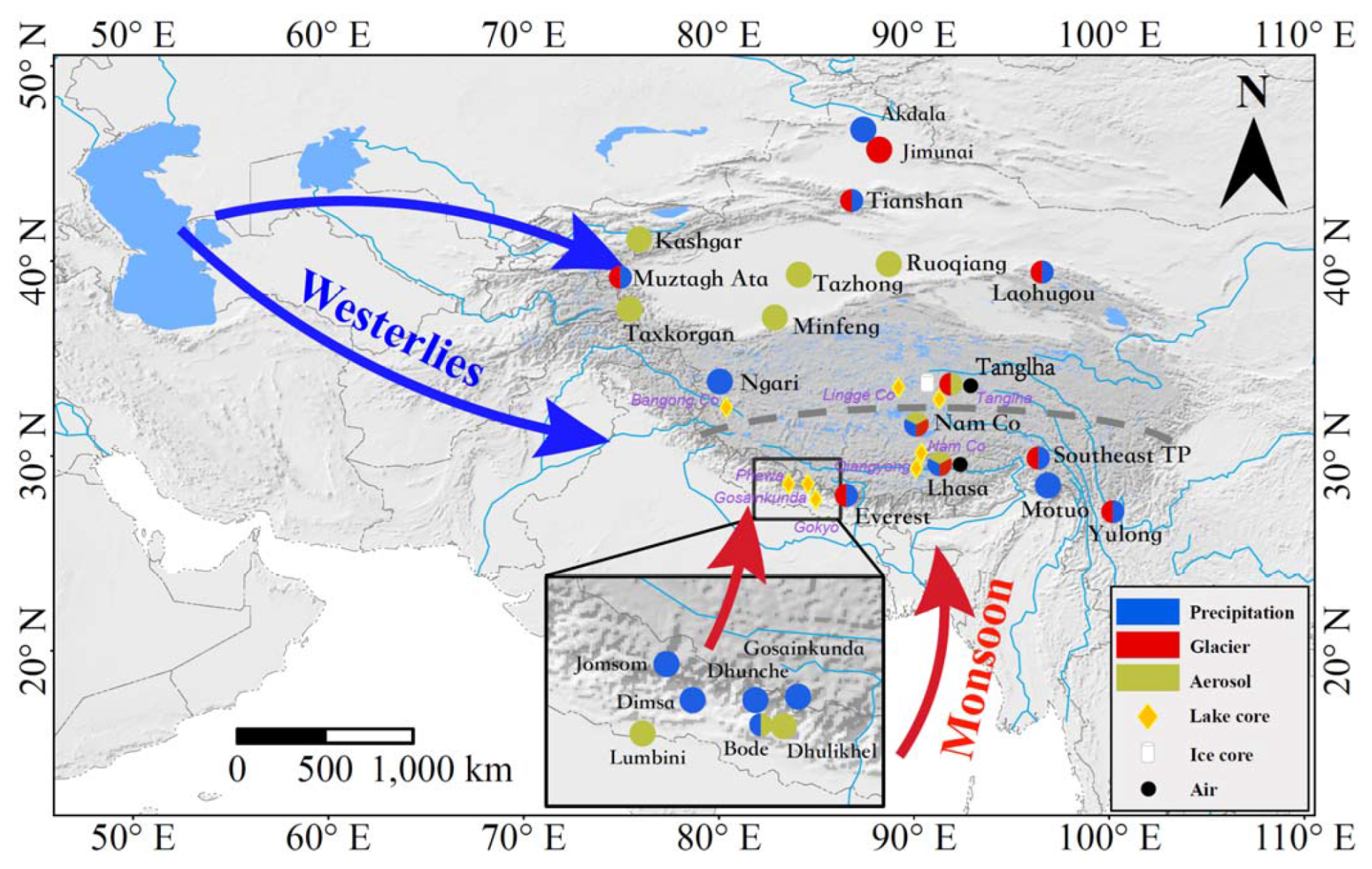
Abstract
The Tibetan Plateau and its surrounding regions, collectively known as the Third Pole, constitute one of Earth’s largest topographic and cryospheric features, playing a pivotal role in the cycling of trace elements at both regional and global scales. Mercury (Hg), a toxic heavy metal of global concern, has garnered increasing attention due to its detrimental effects on environmental and human health. Large-scale atmospheric circulation facilitates the long-range transport of atmospheric Hg pollutants, which can subsequently be deposited across the Third Pole. Over recent decades, the Atmospheric Pollution and Cryospheric Change (APCC) program has established and sustained an integrated monitoring network throughout this region to systematically examine the interactions between Hg biogeochemical cycling and cryospheric changes. This paper presents a comprehensive Hg dataset encompassing air (2 stations), aerosols (9 stations), precipitation (16 stations), glaciers (12 glaciers; including snowpit, surface snow, and cryoconite samples), soils (50 sites), surface waters (53 locations; including river, lake, and glacial meltwater), glacier ice cores (1 core), and lake sediment cores (8 cores) collected across the Third Pole. The data were acquired through both in situ (online) monitoring and laboratory analyses. High-resolution atmospheric Hg concentrations were measured using a Tekran 2537B analyzer at the Nam Co and Tanglha stations. Spatial and temporal distributions of Hg in aerosols, precipitation, glaciers, soils, and sediment cores revealed distinct patterns and trends across different sectors of the Third Pole, influenced significantly by emission sources, transport pathways, and environmental processes. Depositional chronologies derived from glacier ice and lake sediment cores reflect anthropogenic perturbations in the historical Hg record since the Industrial Revolution. Stable Hg isotope compositions from aerosols, soils, and lake sediments provide evidence for transboundary transport of Hg pollution and its northward incursion into the interior Tibetan Plateau from South Asia. This updated dataset is made publicly available to support interdisciplinary research linking the cryosphere, atmosphere, soils, and hydrology. The APCC dataset (v1.0) is archived at the Cold and Arid Regions Science Data Center at Lanzhou, released on 3 December 2024 with the persistent DOI https://doi.org/10.12072/ncdc.qzkk.db6654.2024 (Kang et al., 2024).