2026-07-22 中国科学院(CAS)
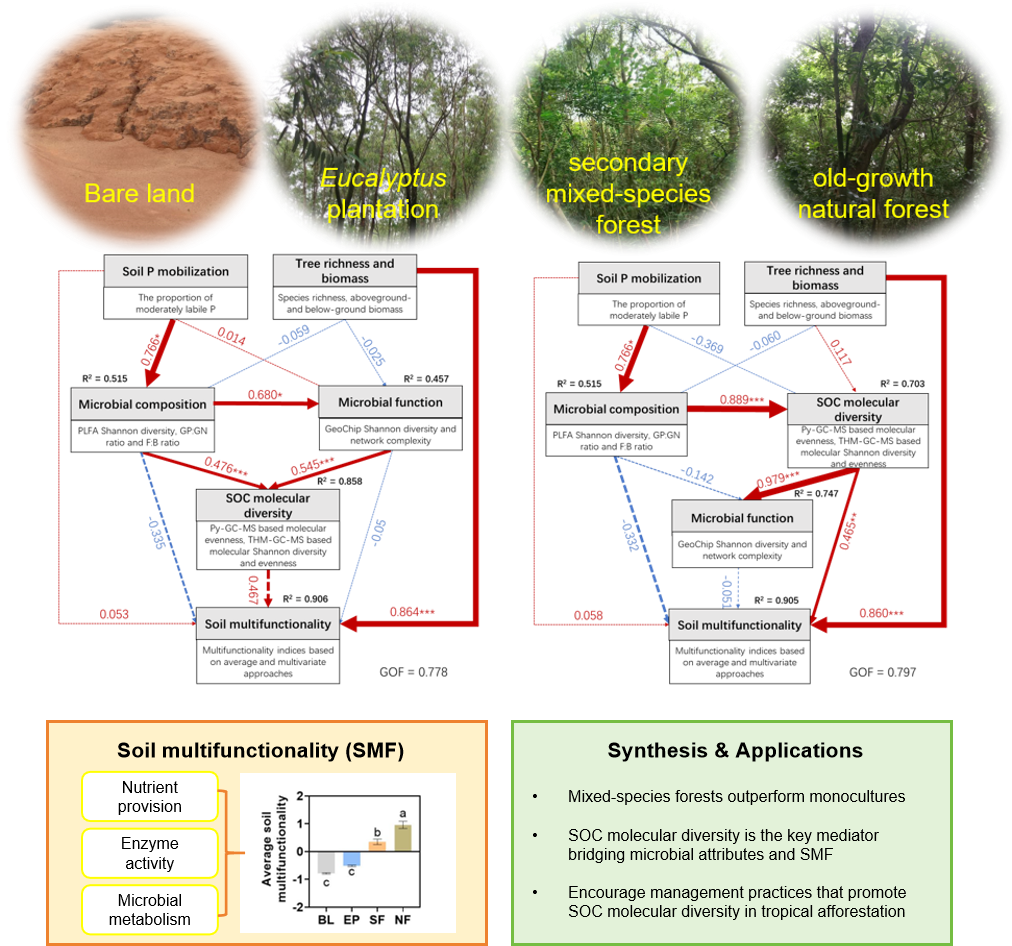
中国科学院(CAS)華南植物園(SCBG)の研究チームは、熱帯の劣化地では単一樹種の植林よりも混交林造成の方が、土壌の多機能性を大きく向上させることを明らかにした。裸地、ユーカリ単一林、二次混交林、天然林を比較し、土壌養分、微生物バイオマス、炭素利用効率、酵素活性など13項目を解析した結果、植林は土壌養分供給や酵素活性を改善し、とくに混交林では微生物群集の多様性と機能遺伝子が増加した。窒素固定、難分解性炭素分解、脱窒、有機リン分解などに関わる機能遺伝子ネットワークも拡大し、土壌機能の協調性が高まった。また、土壌有機炭素(SOC)の分子多様性が、微生物機能と土壌多機能性を結び付ける重要な「生化学的橋渡し」の役割を果たすことを確認した。研究は、熱帯林の生態系回復では植樹本数や炭素貯留量だけでなく、多樹種混植、地下微生物機能、SOC分子多様性を重視することが、長期的な生態系機能の向上に重要であることを示した。
<関連情報>
- https://english.cas.cn/newsroom/research-news/202607/t20260722_1178927.shtml
- https://besjournals.onlinelibrary.wiley.com/doi/10.1111/1365-2664.70509
複数種の植林は、微生物の再構成と土壌有機炭素の分子多様化を通じて土壌の多機能性を高める Mixed-species afforestation enhances soil multifunctionality through microbial reassembly and SOC molecular diversification
Yue Li, Zhijian Mou, Luhui Kuang, Wenjia Wu, Jing Zhang, Faming Wang, Tao Wang, Joeri Kaal, Josep Peñuelas, Jordi Sardans, Daniel F. Petticord, Dafeng Hui, Zhanfeng Liu
Journal of Applied Ecology Published: 19 July 2026
DOI:https://doi.org/10.1111/1365-2664.70509
Abstract
- Afforestation is widely promoted as a means to enhance soil-based ecosystem functions, yet how different planting strategies regulate soil multifunctionality (SMF), including nutrient provision, enzyme activity and microbial metabolism, remains incompletely understood. Existing studies rely heavily on simple microbial diversity metrics and largely overlook soil organic carbon (SOC) molecular diversity, an emerging and under-appreciated dimension of what controls decomposition and nutrient release in soil.
- To clarify how afforestation shapes SMF, we employed a ‘space-for-time substitution’ approach and examined a tropical restoration chronosequence including bare land, an Eucalyptus exserta monoculture, an afforested mixed-species forest and an old-growth natural forest. We quantified SMF using averaging, multivariate and multi-threshold approaches, assessed microbial compositional and functional diversity using phospholipid fatty acids and GeoChip functional arrays, and characterized SOC molecular diversity through analytical pyrolysis techniques.
- Afforestation significantly increased SMF, and mixed-species forest sites had higher SMF values than monoculture. Increases in SMF were associated with shifts in microbial community composition as well as compositional and functional Shannon diversity. SOC molecular diversity emerged as a key mediator linking microbial attributes to SMF, reflecting a mechanism whereby chemically diversified substrates provide multiple soil functions simultaneously.
- Synthesis and applications. By integrating microbial and SOC molecular perspectives, our study identifies the mechanistic links connecting afforestation, soil microbial biodiversity and multifunctionality. These findings support the promotion of mixed-species plantings in tropical afforestation and highlight the importance of improving SOC diversity under afforestation to maximize ecosystem multifunctionality.