2026-06-25 ペンシルベニア州立大学(PennState)
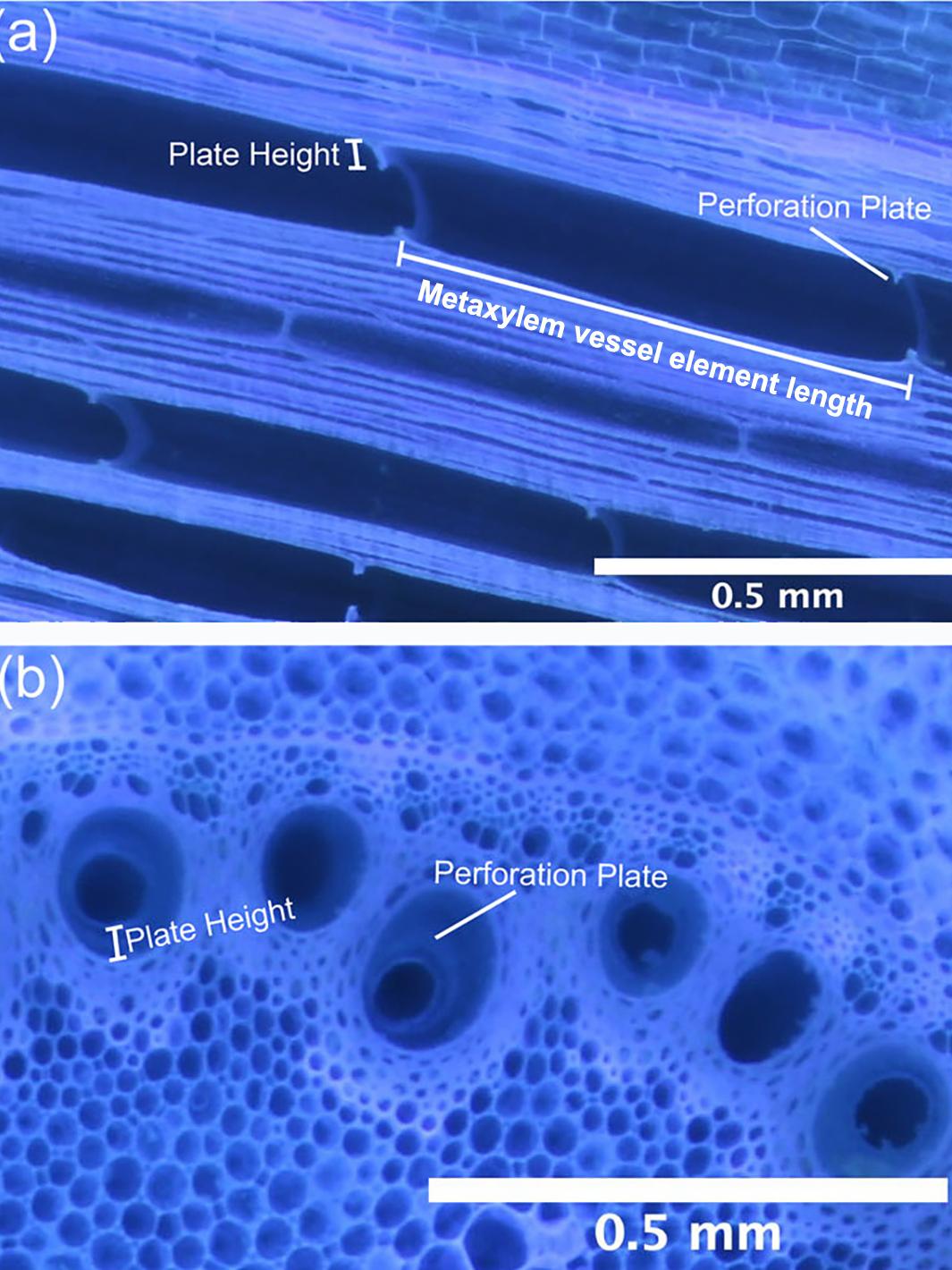
A longitudinal section and a cross-section of corn roots showing perforation plates within the metaxylem vessels and metaxylem vessel element length are shown in these images generated by cryo-scanning electron microscopy. Long, smooth vessels conduct faster flow, creating a more efficient water-transport system, the researchers reported. Credit: Christopher Strock/Penn State. All Rights Reserved.
<関連情報>
- https://www.psu.edu/news/research/story/newly-discovered-corn-trait-may-help-improve-crop-drought-tolerance
- https://acsess.onlinelibrary.wiley.com/doi/10.1002/csc2.70287
トウモロコシでは、多面的「伸長」表現型が、メタキシレム導管要素の長さ、軸方向水力伝導率、根の伸長、水分利用、および干ばつ適応と関連している A pleiotropic “stretch” phenotype is associated with metaxylem vessel element length, axial hydraulic conductance, root elongation, water utilization, and drought adaptation in maize
Christopher F. Strock, Cody L. DePew, Jagdeep S. Sidhu, Tianyu Xu, Jonathan P. Lynch
Crop Sciences Published: 30 April 2026
DOI:https://doi.org/10.1002/csc2.70287
Abstract
We tested the hypothesis that metaxylem phenotypes influence drought adaptation in maize (Zea mays L.) through in silico modeling and empirical studies under water deficit in controlled environments and in the field. Substantial genotypic variation for metaxylem vessel element length (MVEL) was observed. Longer MVEL was correlated with reduced xylem perforation plate height, greater vessel length, and greater axial hydraulic conductance in silico, which was supported by in situ measurements of root segments. Genome-wide association study revealed two different significant single nucleotide polymorphisms associated with MVEL and perforation plate height. Longer MVEL was correlated with greater root elongation, root depth, and deep water utilization in mesocosms. Under drought stress in the field, MVEL was associated with leaf roll, leaf temperature, transpiration, photosynthesis, and grain yield. We conclude that variation for MVEL in maize affects axial hydraulic conductance and is part of a pleiotropic syndrome we term the “stretch phenotype” with greater root elongation and deeper rooting that improves adaptation to water deficit stress.