2026-06-29 中国科学院(CAS)
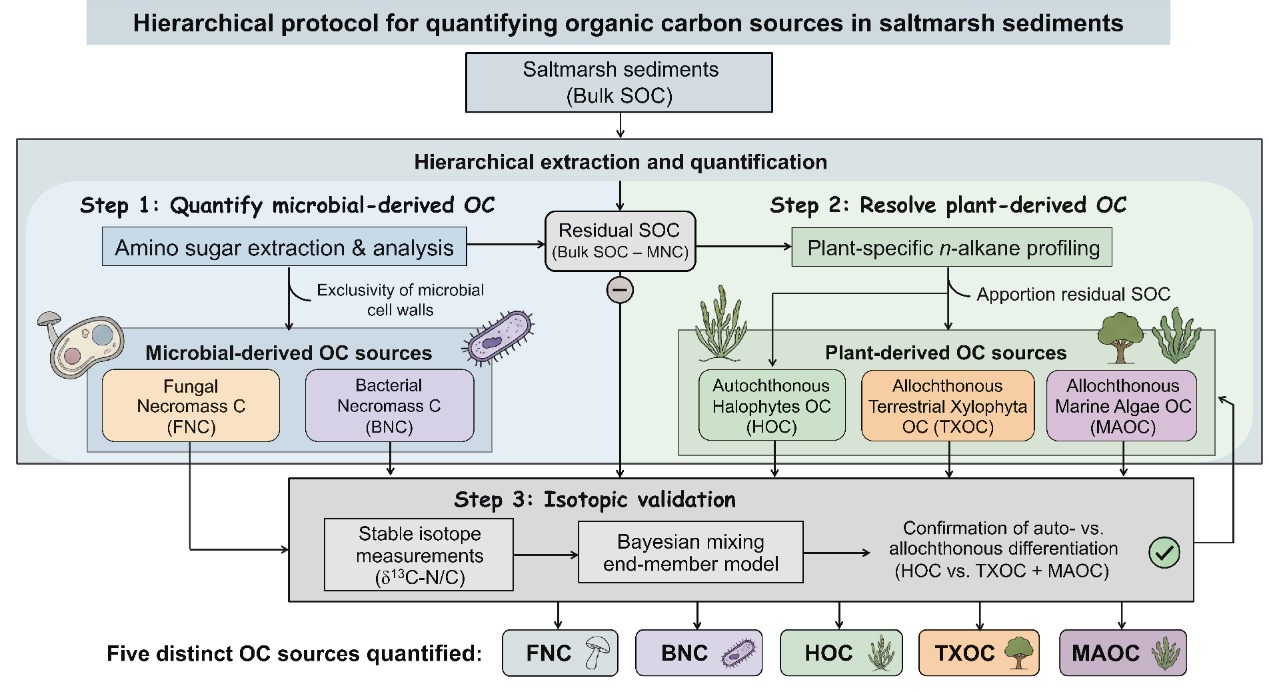
The protocol for quantifying organic carbon sources in saltmarsh sediments. (Image by WANG Faming)
<関連情報>
- https://english.cas.cn/newsroom/research-news/202606/t20260629_1174997.shtml
- https://www.sciencedirect.com/science/article/abs/pii/S0341816226005540
塩性湿地の有機炭素源の解明:信頼性の高いブルーカーボン会計のためのバイオマーカーと同位体の統合 Unravelling saltmarsh organic carbon sources: biomarker-isotopic integration for credible blue carbon accounting
Jinge Zhou, Hua He, Han Chen, Jingfan Zhang, Zhe Lu, Shuchai Gan, Guoming Qin, Lulu Zhang, Xingyun Huang, Neil Saintilan, Ding He, Yongxia Jia, Yongxing Li, Yingwen Li, Hui Li, Faming Wang
CATENA Available: online 26 June 2026
DOI:https://doi.org/10.1016/j.catena.2026.110344
Highlights
- Integrates n-alkanes and amino sugars to quantify five organic carbon sources.
- Reveals that local halophytes contribute 37.7–58.6% of saltmarsh sedimentary carbon.
- Provides a verifiable framework for blue carbon credit certification and allocation.
- Informs wetland restoration strategies to prioritize autochthonous plant productivity.
Abstract
Saltmarshes are vital coastal blue carbon (C) ecosystems (BCEs) that store large amounts of organic C (OC) in sediments. This OC originates from both local (autochthonous) and external (allochthonous) marine or terrestrial sources. Accurately quantifying these OC sources is crucial for effectively allocating blue C credits. In this study, we investigated the sources of sedimentary organic carbon (SOC) in two representative Chinese saltmarshes, each characterized by distinct vegetation communities (Spartina alterniflora, Suaeda salsa, and Phragmites australis). By integrating n-alkane signatures (plant sources) and amino sugars (microbial necromass) with δ13C-N/C analysis, we quantify five distinct OC sources: autochthonous plant-derived halophytes OC, allochthonous terrestrial xylophyta OC, and allochthonous marine algae OC, as well as microbial-derived fungal necromass C, and bacterial necromass C. The analysis revealed that plant residues predominate in the SOC, contributing over 75%. Notably, autochthonous untransformed plant-derived OC consistently constituted the highest proportion, ranging from 36.9% to 58.2%. Furthermore, soil texture and nutrient composition were key factors regulating plant- and microbial-derived OC, with distinct pathways mediating these effects. Isotopic validation confirmed biomarker reliability. Our results provide a methodological basis for improving source-resolved blue carbon accounting in saltmarshes, although broader application requires local endmember calibration and consideration of uncertainty.