2026-06-22 スイス連邦工科大学ローザンヌ校(EPFL)
<関連情報>
- https://actu.epfl.ch/news/the-hidden-atmospheric-cost-of-arctic-shipping/
- https://iopscience.iop.org/article/10.1088/1748-9326/ae6673
中央北極におけるエアロゾルと雲の相互作用における、局地的な船舶排出物の役割 The role of local shipping emissions in aerosol-cloud interactions in the central Arctic
Benjamin Heutte, Sébastien Rogers, Hélène Angot, Ivo Beck, Nora Bergner, Jessie M Creamean, Lubna Dada, Silvia Henning, Tuija Jokinen, Michael Lonardi, Athanasios Nenes, Tuukka Petäjä, Roman Pohorsky, Kerri A Pratt, Lauriane L J Quéléver and Julia Schmale,…
Environmental Research Letters Published: 19 May 2026
DOI:10.1088/1748-9326/ae6673
Abstract
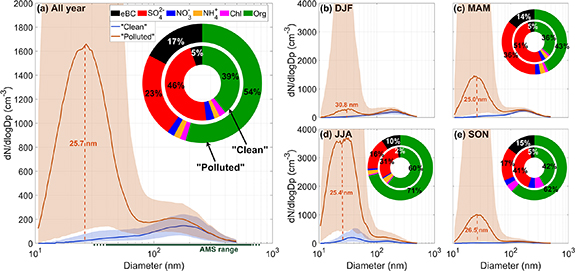
Arctic shipping is projected to increase as sea ice retreats, yet the impact of modern low-sulfur ship emissions on Arctic clouds and radiation remain poorly constrained. We use year-long in situ observations from the MOSAiC expedition to characterize ship-aerosol-cloud interactions for an icebreaker burning ultra-low sulfur fuel (0.1% mass per mass). Exhaust plumes were found to be strongly enriched in Aitken-mode particles, organic aerosol, and black carbon, but showed no detectable enhancement in particulate sulfate. Despite reduced hygroscopicity relative to ambient aerosols, ship emissions substantially increased local cloud condensation nuclei concentrations. A droplet activation parameterization was applied to quantify responses in cloud droplet number concentration (Nd) to ship-induced perturbations in low-level Arctic clouds. In winter, abundant background accumulation-mode particles from Arctic haze supplied nearly all cloud droplets, while additional particles from ship emissions had little impact on Nd. In contrast, during summer months, when unperturbed background aerosol concentrations are low, ship emissions nearly doubled Nd compared to average background conditions and increased Nd by a factor of five compared to very clean background conditions (25th percentile of background aerosol number concentrations). Longwave radiative transfer simulations for typical conditions of summer Arctic low-level clouds/fog suggest that these ship-induced increases in Nd locally (i.e. <100 km downwind) lead to enhanced net surface longwave fluxes and consequent warming, primarily for optically thin clouds (liquid water path (LWP) ⩽ 30 g·m−2). For LWP = 10 g · m−2, ship emissions lead to an increase of 1 W · m−2 in cloud longwave forcing at the surface compared to average unperturbed conditions (+7% relative increase), and up to 4 W · m−2 when compared to very clean background conditions (+22% relative increase). Even ultra-low sulfur fuel emissions can therefore locally and episodically modify Arctic cloud microphysics and radiative properties, especially during summer, implying that future increases in Arctic shipping could have non-negligible regional climate impacts.