
2026-05-28 名古屋工業大学,科学技術振興機構,名古屋大学,金沢大学,東京都立大学
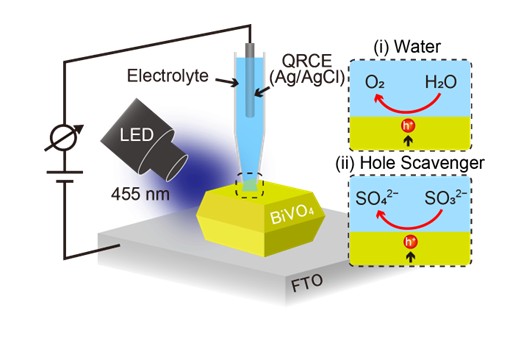
SECCMの模式図
<関連情報>
- https://www.nitech.ac.jp/news/press/2026/14004.html
- https://pubs.acs.org/doi/10.1021/acsenergylett.6c01004
走査型電気化学セル顕微鏡による粒子ベースBiVO4光アノード上での面依存性光電気化学酸化の調査 Facet-Dependent Photoelectrochemical Oxidation on Particle-Based BiVO4 Photoanode Investigated by Scanning Electrochemical Cell Microscopy
Kota Honda,Kaito Hirata,Fumiaki Amano,Takeshi Fukuma,and Yasufumi Takahashi
ACS Energy Letters Published: May 26, 2026
DOI:https://doi.org/10.1021/acsenergylett.6c01004
Abstract
Facet engineering plays a crucial role in improving photoelectrochemical (PEC) water splitting efficiency. However, the facet-dependent reaction mechanisms in photoelectrodes remain unclear, which hinders rational design. In this study, we employed scanning electrochemical cell microscopy (SECCM) to visualize the distribution of the local PEC oxidation reaction of faceted BiVO4-based photoanodes. The SECCM results revealed that the PEC water and hole scavenger oxidation preferentially occurred on the {010} facet rather than on the {110} facet. These results contradict the charge separation mechanisms driven by a built-in electric field (BEF) in unbiased BiVO4 photocatalysts, which indicates that the BEF is not the most dominant factor governing carrier transport under an applied bias. Instead, our results suggest that superior carrier mobility along the [010] direction is preferred for hole transport and enhanced PEC activity on the {010} facet. These findings indicate the dominant role of carrier transport properties in determining facet-dependent PEC performance and reveal the limitations of the direct application of photocatalyst-based mechanisms to photoelectrode design.

