026-05-25 中国科学院(CAS)
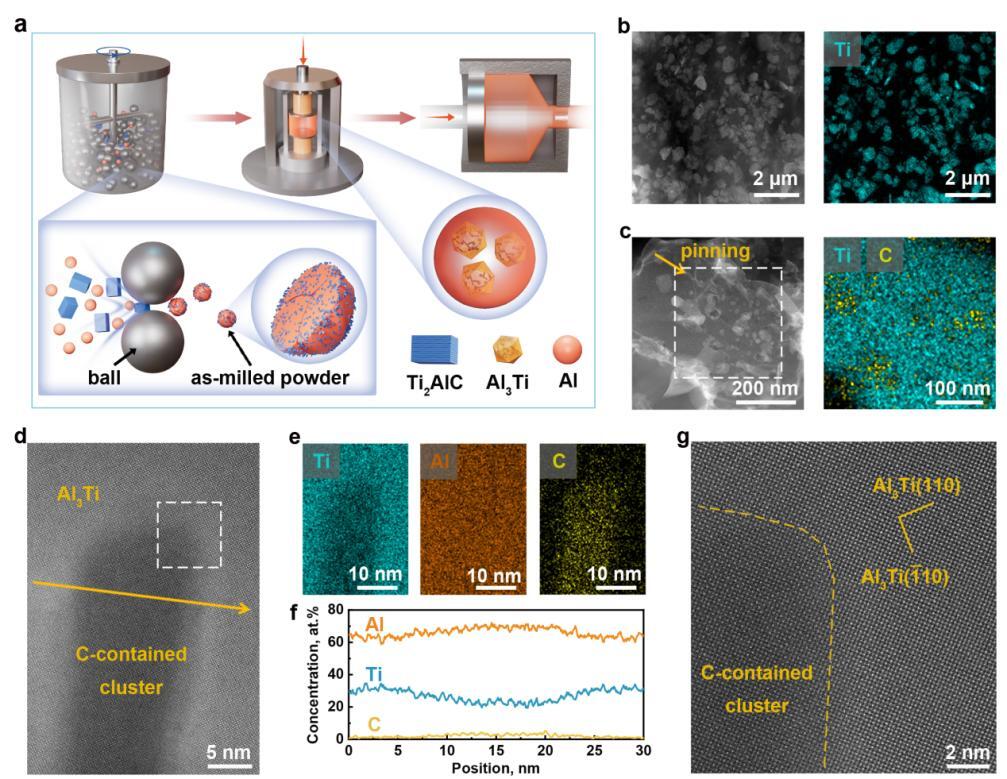
Fabrication process and microstructure of the composite. (Image by IMR)
<関連情報>
- https://english.cas.cn/newsroom/research-news/202605/t20260526_1159894.shtml
- https://www.nature.com/articles/s41467-026-73160-7
階層的な強化戦略により、高温での機械的特性を損なうことなくアルミニウムマトリックス複合材料を実現できます Hierarchical reinforcement strategy enables aluminum matrix composites with uncompromised high-temperature mechanical properties
H. J. Hu,Y. H. Shi,Y. N. Zan,M. Song,D. Wang,Q. Z. Wang,L. H. He,W. Yin,B. L. Xiao & Z. Y. Ma
Nature Communication Published:13 May 2026
DOI:https://doi.org/10.1038/s41467-026-73160-7 Unedited version
Abstract
An aluminum matrix composite with enhanced high-temperature strength and modulus is developed in this study using powder metallurgy, incorporating high-energy ball milling-controlled in-situ reactions between the Ti2AlC (MAX phase) precursor and aluminum (Al) matrix. High-energy ball milling induces a dual-pathway elemental diffusion architecture in Ti2AlC, enabling the internal decomposition mechanism in Ti2AlC and producing a hierarchical microstructure. This structure contains (1) 0.42 μm and 38.6 vol.% Al3Ti particles uniformly dispersed in the Al matrix (0.32 μm), and (2) intraparticle carbon-contained clusters and rod-like phases (2–100 nm), enhancing Al3Ti strength. This multi-level architecture achieves high strength and stiffness at elevated temperatures, with ultimate tensile strength values of 632 MPa (room temperature) and 246 MPa (350 °C) and corresponding Young’s modulus values of 124 GPa and 106 GPa, respectively. At 350 °C, the specific modulus of the composite surpasses that of Ti (TC4), Cu (QZr0.2), steel (45 steel), and Ni (GH93) by 88%, 190%, 55%, and 42%, respectively, which positions it as a competitive candidate for lightweight structural materials in high-temperature applications.