2026-05-22 筑波大学
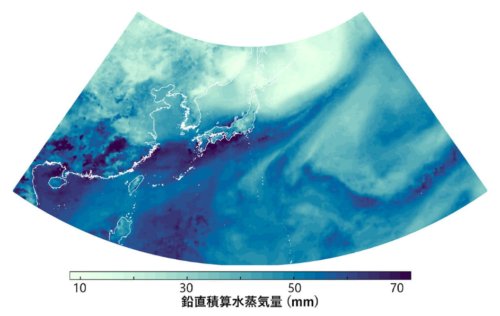
大量の水蒸気が、巨大な川のように低緯度域から中緯度地域に流れ込む現象が「大気の川」です。日本列島に水害をもたらすため、大きな注目を集めています。地球温暖化の影響と太平洋高気圧の強まりに伴って、その流量が過去42年間(1981~2022年)で約8%強まっていたことを見いだしました。
<関連情報>
- https://www.tsukuba.ac.jp/journal/biology-environment/20260522140000.html
- https://link.springer.com/article/10.1007/s00382-026-08189-x
1980年代以降の北太平洋高気圧西縁を流れる大気の川による水蒸気輸送量の増加 Increased water vapor transports of atmospheric rivers around the western flank of the North Pacific High since the 1980s
Youichi Kamae,Kazuya Wakao & Tomonori Sato
Climate Dynamics Published:19 May 2026
DOI:https://doi.org/10.1007/s00382-026-08189-x
Abstract
During the previous decade, intense and widespread heavy rainfall has occurred occasionally in midsummer over East Asia around the western flank of the North Pacific High. Such extreme events share the common feature of a synoptic-scale band of intense water vapor transport called an atmospheric river (AR). However, using observational data, it is difficult to detect trends in the intensity of ARs owing to the complex effects of internal climate variability and diversity in synoptic weather patterns. Herein, using the technique of self-organizing maps to delineate their effects, we found an increasing trend of AR-related water vapor transport of 8.3 ± 2.3% between 1981 and 2022. Enhanced low-level southerly and southwesterly winds transported more water vapor over the Korean Peninsula and Japan. This trend of the atmospheric circulation is closely related to the decadal-scale oscillation over the Pacific Ocean and resultant enhancement of the North Pacific High. In addition to dynamic intensification of ARs, robust increase in water vapor content associated with rising air temperature also contributed to AR intensification. These results suggest that the trend of increase in AR intensity could continue over coming decades, although with increasing fluctuation on the decadal time scale.