2026-05-20 中国科学院(CAS)
<関連情報>
- https://english.cas.cn/newsroom/cas-in-media/202605/t20260520_1159655.shtml
- https://iopscience.iop.org/article/10.3847/1538-4357/ae4592
若い銀河ハローパルサーのタイミングとシンチレーション Timing and Scintillation of a Young Galactic Halo Pulsar
J. M. Yao, F. F. Kou, J. P. Yuan, Y. Wei, William A. Coles, Richard N. Manchester, N. Wang, S. Q. Wang, and W. M. Yan
The Astrophysical Journal Published: 2026 March 9
DOI:10.3847/1538-4357/ae4592
Abstract
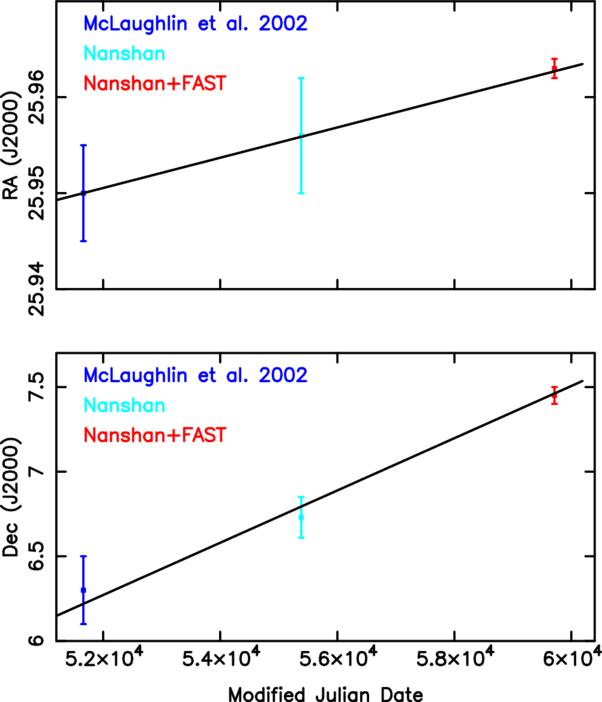
We conducted a timing and scintillation study of a young Galactic halo pulsar, PSR J1740+1000, using observations from the Nanshan, FAST, and Parkes radio telescopes. From a timing analysis, we measured the proper motion of this pulsar for the first time. The proper motion measurement indicates that the pulsar is moving away from the Galactic plane at a position angle of 16:7 ± 4:8 (in Galactic coordinates), with a total proper motion of 56.9 ± 8.0 mas yr−1 and a corresponding transverse velocity of 329 ± 80 km s−1. This velocity suggests that PSR J1740+1000 is a typical-velocity, young pulsar born within the Galactic halo. For scintillation, we detected scintillation arcs, arclets, and double-layered adjacent arcs in the secondary spectra. Under the isotropic and anisotropic scattering cases, the screen-to-pulsar distance is 370 ± 72 and 1 ± 12 pc, respectively. The latter value closely matches the scale of the pulsar wind nebula (PWN) associated with PSR J1740+1000 and provides a better fit, suggesting that its scattering is most likely dominated by the PWN. The double-layered adjacent arcs observed on MJD 60180 imply that the pulsar’s scattered image consists of two dominant components (A and B), along with multiple weaker components. Component A is located at the pulsar’s geometric position with an angular position of 0 μas, while Component B is located 112 ± 16 and 23 ± 17 μas away from the central component under the isotropic and anisotropic scattering cases, respectively. Since the angular position of Component B is independent of observing frequency, this hints at refraction by an au-scale structure located within the scattering region, which may originate from the PWN.