2026-05-19 中国科学院(CAS)
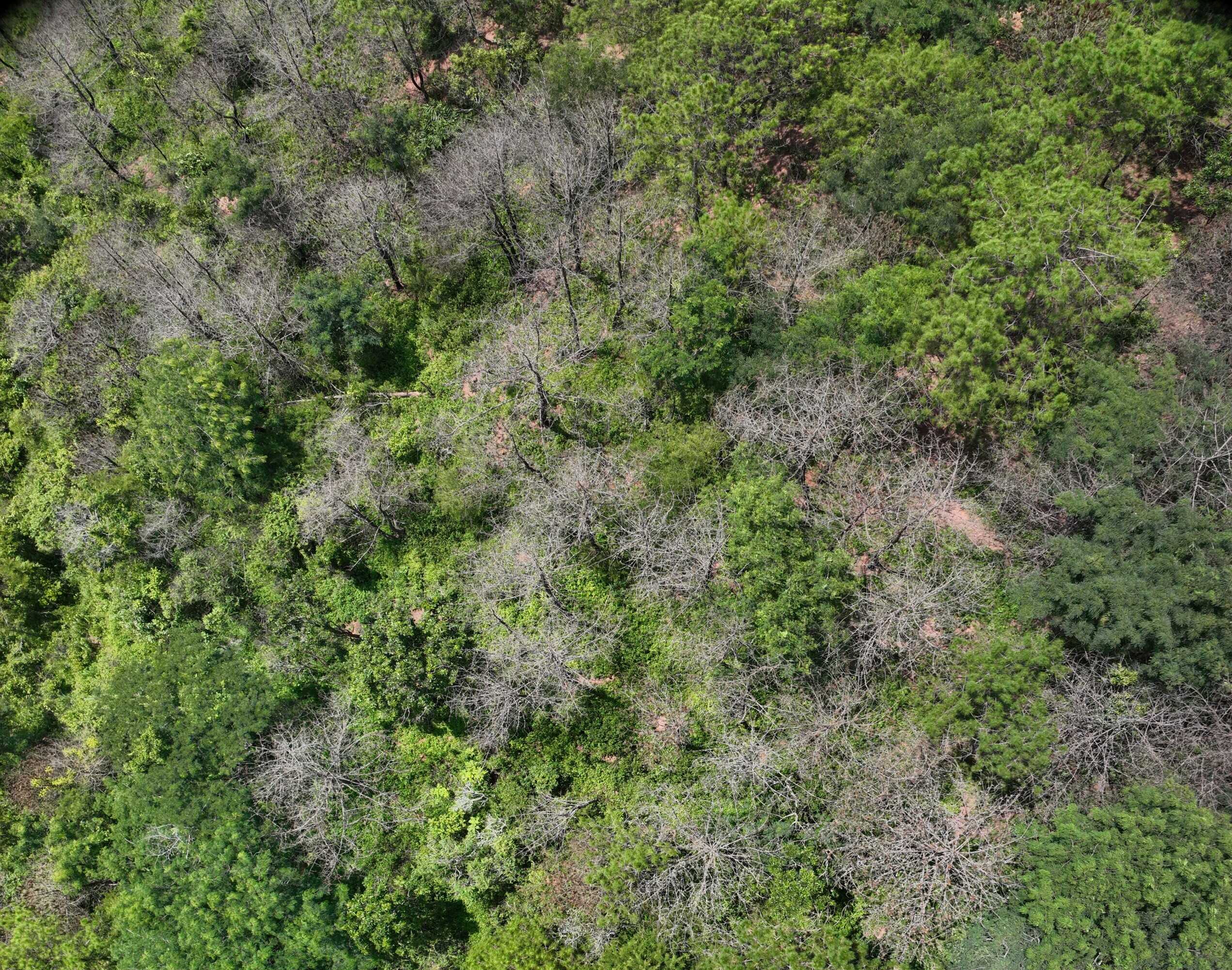
Forest of Pinus kesiya var. langbianensis (Simao pine) after drought. (Image by GAO Daoxiong)
<関連情報>
- https://english.cas.cn/newsroom/research-news/202605/t20260519_1159582.shtml
- https://www.sciencedirect.com/science/article/abs/pii/S0378112726003531
中国南西部における2種のマツの干ばつによる枯死は、植生の水分状態と地形によって左右される Vegetation water status and topography shape drought-induced dieback of two Pinus species in Southwest China
Dao-Xiong Gao, Rao-Qiong Yang, Pei-Li Fu, De-Li Zhai, Ze-Xin Fan
Forest Ecology and Management Available online: 13 May 2026
DOI:https://doi.org/10.1016/j.foreco.2026.123855
Highlights
- Dry-season NDWI anomaly is the strongest and most consistent dieback predictor in both pines.
- P. yunnanensis dieback is driven by soil and stand structural traits.
- P. kesiya var. langbianensis vulnerability is primarily governed by local topography.
- Both species face high dieback risks near their climatic range margins.
Abstract
Extreme droughts increasingly trigger forest dieback globally, yet how species-specific physiological strategies interact with local micro-environments to shape landscape-scale mortality patterns remains poorly understood. Here, we integrated unmanned aerial vehicle (UAV) surveys from 20 large plots (4 ha each; 10 per species), satellite-derived vegetation indices, and environmental data to investigate a severe 2023 die-off event of Pinus yunnanensis Franch (Yunnan pine) and Pinus kesiya var. langbianensis (A. Chev.) Gaussen ex Bui (Simao pine) in Southwest China. UAV observations revealed moderate but spatially heterogeneous canopy dieback, with rates ranging from 1.05% to 6.47% in P. yunnanensis and from 0.53% to 11.16% in P. kesiya var. langbianensis, predominantly concentrated on south-facing slopes. At the pixel level, satellite-based analyses showed pronounced declines in the normalized difference water index (NDWI) during 2023, accompanied by divergent post-drought trajectories between dieback (upper-quartile) and healthy (zero-dieback) pixels. In P. yunnanensis, dieback pixels exhibited a near-complete collapse in both resistance and resilience, indicating irreversible damage. Conversely, P. kesiya var. langbianensis showed rapid but incomplete recovery, suggesting a persistent drought legacy despite compensatory growth. These contrasting pixel-level responses were governed by distinct constraints: dieback in P. yunnanensis was primarily driven by intrinsic stand characteristics (e.g., age, canopy height) and soil potassium, whereas P. kesiya var. langbianensis was predominantly constrained by topographic conditions, especially slope. Despite these differences, dry-season NDWI anomalies consistently emerged as a robust predictor of dieback hotspots, which were disproportionately located near species distribution margins. Together, our results provide new mechanistic insight into species-specific drought vulnerability and highlight the importance of integrating multi-scale observations to improve predictions of forest dieback under climate change. These findings further suggest that effective adaptation strategies should move beyond generalized vulnerability assessments toward species-specific management interventions.