

2026-05-18 産業技術総合研究所
<関連情報>
- https://www.aist.go.jp/aist_j/press_release/pr2026/pr20260518/pr20260518.html
- https://advanced.onlinelibrary.wiley.com/doi/10.1002/adsc.70463
過酸化水素存在下、カルボン酸を用いずにチタンシリカライト-1触媒の二重機能性を利用したアルケンからの1,2-ジオールの選択的連続フロー合成 Selective Continuous-Flow Syntheses of 1,2-Diols From Alkenes by Utilizing a Dual Functionality of Titanium Silicalite-1 Catalyst in the Presence of Hydrogen Peroxide Without Carboxylic Acids
Yoshihiro Kon, Takuya Nakashima, Hiroki Nagashima, Yoshiki Makino, Syun-ya Onozawa, Hiroyuki Miyamura, Shū Kobayashi
Advanced Synthesis & Catalysis Published: 28 April 2026
DOI:https://doi.org/10.1002/adsc.70463
Abstract
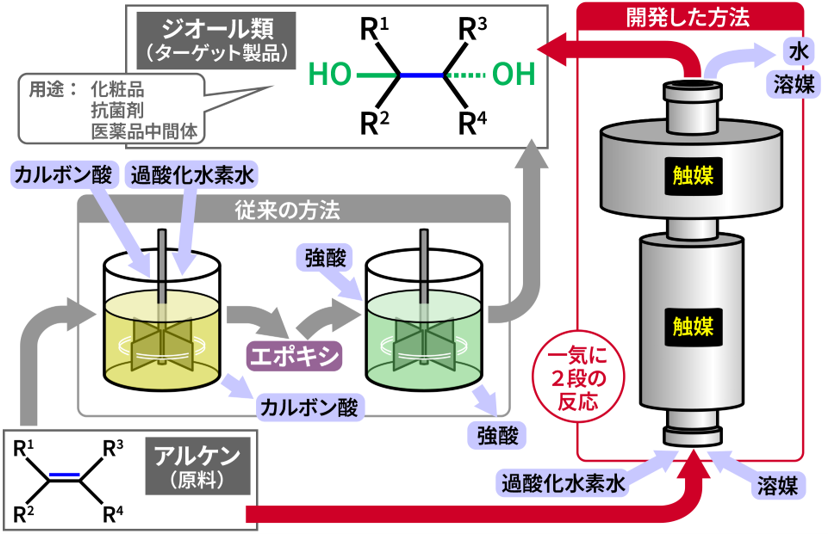
Selective syntheses of 1,2-diols from alkenes have traditionally relied on carboxylic acids and various oxidants, which often co-produce hazardous byproducts. This report describes a simple, carboxylic-acid-free method to produce various aliphatic and cyclic diols from their corresponding alkenes in 51–96% isolated yields using 2.0 wt% aqueous hydrogen peroxide (H2O2). We developed a tandem continuous-flow process that exploits the dual functionality (peroxo-species formation and Lewis acidity) of a titanium silicalite-1 (TS-1) catalyst. In this system, alkenes undergo H2O2 epoxidation followed by in situ hydration to yield the desired 1,2-diols. Optimal reaction conditions, including the use of a ternary mixed solvent (EtOH:iPrOH:MeCN = 1:1:1), were established through probe reactions and kinetic studies. Furthermore, catalyst degradation was rigorously analyzed using dynamic nuclear polarization-nuclear magnetic resonance. The long-term stability of the process was demonstrated by the continuous synthesis of 4-phenylbutane-1,2-diol for 200 h, maintaining an average yield of over 91% (22.2 g isolated).

