2026-05-18 東北大学
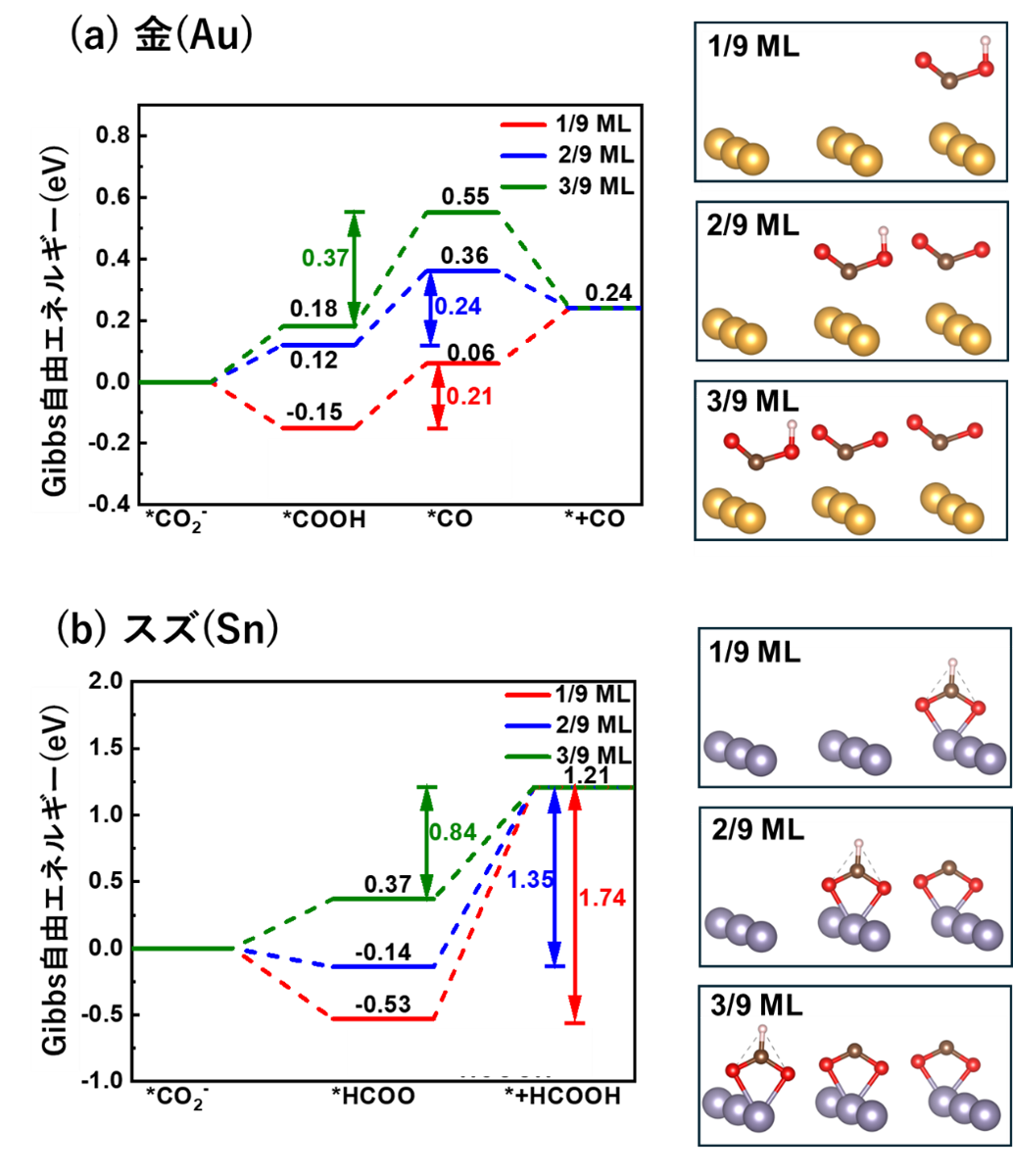
図1. 金(Au(110))およびスズ(Sn(100))触媒上におけるCO2還元反応経路の自由エネルギー(1/9MLは9つのCO2吸着サイトにCO2分子が1つ吸着していることを示します)。
(a) 金触媒:CO2がCOOHなどの中間体を経て一酸化炭素(CO)へ変換されます。
(b) スズ触媒:CO2がHCOO中間体を経てギ酸(HCOOH)へ変換されます。縦軸の「Gibbs自由エネルギー」は反応の進みやすさを表す指標で、値が低いほどエネルギー的に安定であり、反応が進みやすいことを意味します。
<関連情報>
- https://www.tohoku.ac.jp/japanese/2026/05/press20260518-01-co2.html
- https://pubs.acs.org/doi/10.1021/acscatal.6c00443
高圧下における非単調なCO2還元選択性:濃度駆動領域から電荷移動制御へ Non-Monotonic CO2 Reduction Selectivity under High Pressure: From Concentration-Driven Regime to Charge-Transfer Regulation
Xishuo Zhang,Kazuyuki Iwase,Ryusei Takayanagi,Yusuke Hashimoto,and Takaaki Tomai
ACS Catalysis Published: May 15, 2026
DOI:https://doi.org/10.1021/acscatal.6c00443
Abstract
Achieving high electrochemical activity together with precise control over product selectivity remains a central challenge in the electrochemical CO2 reduction reaction (CO2RR). Operating under elevated pressure has been recognized as an effective approach to increase CO2 concentration at the electrode interface and enhance CO2RR rates. However, the intrinsic mechanisms by which pressure governs reaction pathways in CO2 electroreduction remain poorly understood. To clearly highlight the pressure effect, we employ high-pressure conditions up to 20 MPa. High-pressure electrochemical experiments combined with density functional theory (DFT) calculations are employed to systematically investigate the pressure-dependent behavior of CO2RR on Au and Sn catalysts. Experimentally, increasing CO2 pressure from 5 to 15 MPa significantly enhances the overall reaction activity due to improved CO2 solubility and driving the system into a concentration-driven regime. At higher pressure (20 MPa), however, Au exhibits a non-monotonic response with a decline in CO selectivity, whereas Sn maintains a continuous enhancement toward formate (HCOO−). Theoretical analysis reveals that high CO2 surface coverage at elevated pressure induces the reduction of the electron gain per CO2 molecule, leading to the enhancement of the C−O bond strength. Because of coverage-dependent changes in the stability and reaction barriers of key intermediates, the *COOH → *CO pathway on Au becomes unfavorable, while the *HCOO → HCOO–/HCOOH pathway on Sn becomes favorable. These results demonstrate that, beyond concentration-driven enhancement effects, coverage-induced electronic effects play a decisive role in regulating CO2RR selectivity under sufficiently high-pressure conditions.