2026-05-14 中国科学院(CAS)
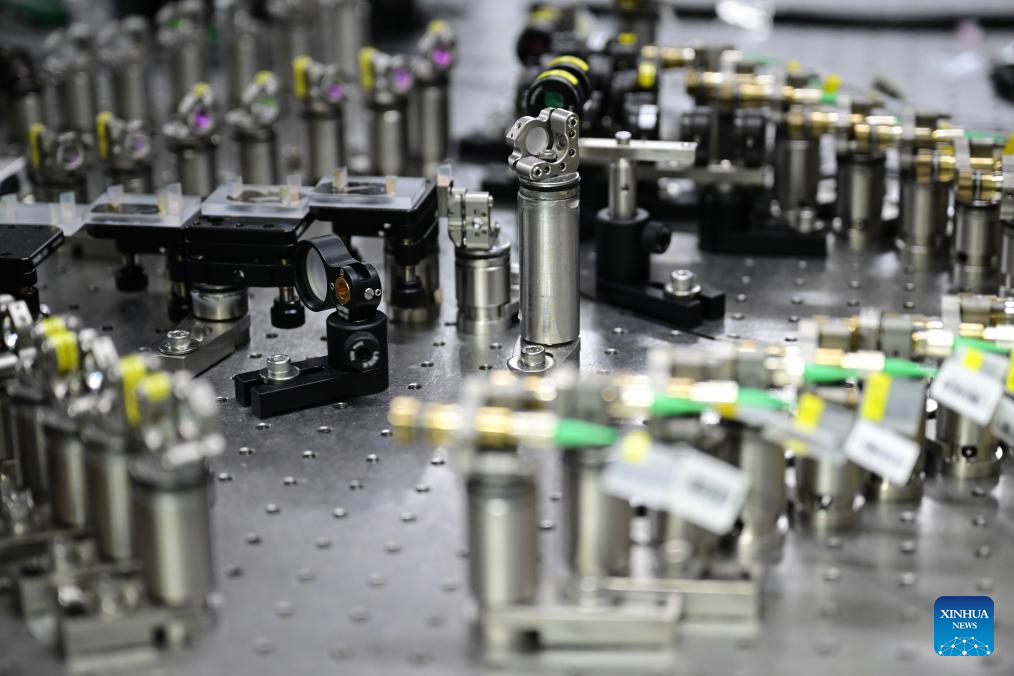
This photo taken on April 10, 2026 shows part of a programmable quantum computing prototype called “Jiuzhang 4.0”. (Xinhua/Zhou Mu)
<関連情報>
- https://english.cas.cn/newsroom/headlines/202605/t20260514_1159331.shtml
- https://www.nature.com/articles/s41586-026-10523-6
8,176モードにおける1,024個のスクイーズド状態を用いたガウスボソンのサンプリング Gaussian boson sampling with 1,024 squeezed states in 8,176 modes
Hua-Liang Liu,Hao Su,Yu-Hao Deng,Si-Qiu Gong,Yi-Chao Gu,Hao-Yang Tang,Meng-Hao Jia,Qian Wei,Yu-Kun Song,Dong-Zhou Wang,Ming-Yang Zheng,Fa-Xi Chen,Li-Bo Li,Si-Yu Ren,Xue-Zhi Zhu,Mei-Hong Wang,Yao-Jian Chen,Yan-Fei Liu,Long-Sheng Song,Peng-Yu Yang,Jun-Shi Chen,Hong An,Lei Zhang,Lin Gan,… Jian-Wei Pan
Nature Published:13 May 2026
DOI:https://doi.org/10.1038/s41586-026-10523-6
Abstract
The development of large-scale, high-fidelity quantum processors is a fundamental scientific challenge, essential for exploring the boundaries of classical computation and advancing towards fault-tolerant systems. Gaussian boson sampling not only serves as a prominent model for demonstrating quantum computational advantage1,2,3 but can also generate bosonic error-correcting codes for fault-tolerant quantum computing4,5,6. However, its scalability has been hindered by significant photon loss in increasingly large and complex encoding circuits. Here we show a programmable photonic quantum processor, Jiuzhang 4.0, which incorporates 1,024 high-efficiency squeezed states into a hybrid spatial–temporal encoded 8,176-mode circuit. By achieving 92% source efficiency and 51% overall system efficiency, the processor produces samples with detection events up to 3,050 photons, representing an order-of-magnitude increase in scale over previous demonstrations7,8,9,10. This architecture realizes a cubic scaling of connectivity (163 = 4, 096), enabling sampling within a Hilbert space of dimension approximately 102,461. The experimental results are rigorously validated against all current classical simulation methods, especially the matrix product state algorithms recently designed to exploit photon loss11. The ability to control thousands of photons in programmable low-loss quantum processors pushes the experimental frontier into a regime far beyond classical tractability and opens a pathway to trillion-qumode three-dimensional cluster states and fault-tolerant photonic quantum hardware.