2026-05-14 兵庫県立大学
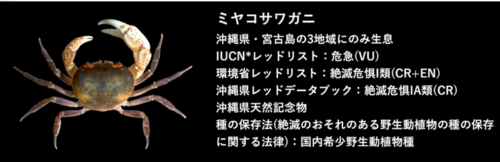
図1. 宮古島固有種のミヤコサワガニ. 生息環境が減退し, 絶滅の危機に瀕している.
<関連情報>
- https://www.u-hyogo.ac.jp/news/pressrelease/press20260514.html
- https://www.u-hyogo.ac.jp/press20260514.pdf
- https://link.springer.com/article/10.1007/s10592-026-01785-8
隔離された島固有のカニ:ミヤコサワガニの局所スケールでの遺伝的集団構造 Isolated island endemic crabs: Fine-scale genetic population structure of an endangered freshwater crab, Geothelphusa miyakoensis
Takefumi Yorisue,Akira Iguchi,Miyuki Nishijima,Kodai Gibu,Saki Higa,Nina Yasuda,Kenji Takata,Kohei Hamamoto & Yoshihisa Fujita
Conservation Genetics Published:22 April 2026
DOI:https://doi.org/10.1007/s10592-026-01785-8
Abstract
Geothelphusa miyakoensis is an endangered freshwater crab endemic to Miyako Island, in the southern Ryukyu Islands, Okinawa Prefecture, Japan. Due to habitat fragmentation resulting from island development, only four small habitat sites remain. Therefore, conservation priority for G. miyakoensis is extremely high and viability of each population needs to be urgently assessed. In this study, we collected DNA samples from three (Ngtaga-ga, Higa-Upuka and Puikya) of the four habitats and performed genetic analyses based on mitochondrial COI sequences and genome-wide SNPs. We detected significant genetic structure among these populations, indicating that gene flow among them is highly restricted. Furthermore, the reduction in effective population size due to habitat loss raises concerns about the negative effects of inbreeding depression in each population. In particular, Puikya requires special attention due to its extremely limited habitat size (about 80 m2) and the lowest genetic diversity. Moving forward, it is desirable to conserve the remaining habitats and to implement conservation measures for each population. Furthermore, it is important to continue monitoring genetic diversity and population dynamics to ensure that inbreeding depression does not become severe.