2026-05-11 東京大学
<関連情報>
セリウム同位体分析により、酸素極小帯から太平洋深海まで全域で発生している水素起源の鉄マンガン被覆が明らかになった Cerium isotopes unveil hydrogenetic Fe-Mn encrustation occurring throughout from the oxygen minimum zone to the deep pacific
Wenshuai Li, Ryoichi Nakada, Hajime Obata, Naoya Kanna, […] , and Yoshio Takahashi
Science Advances Published:1 May 2026
DOI:https://doi.org/10.1126/sciadv.aee2813
Abstract
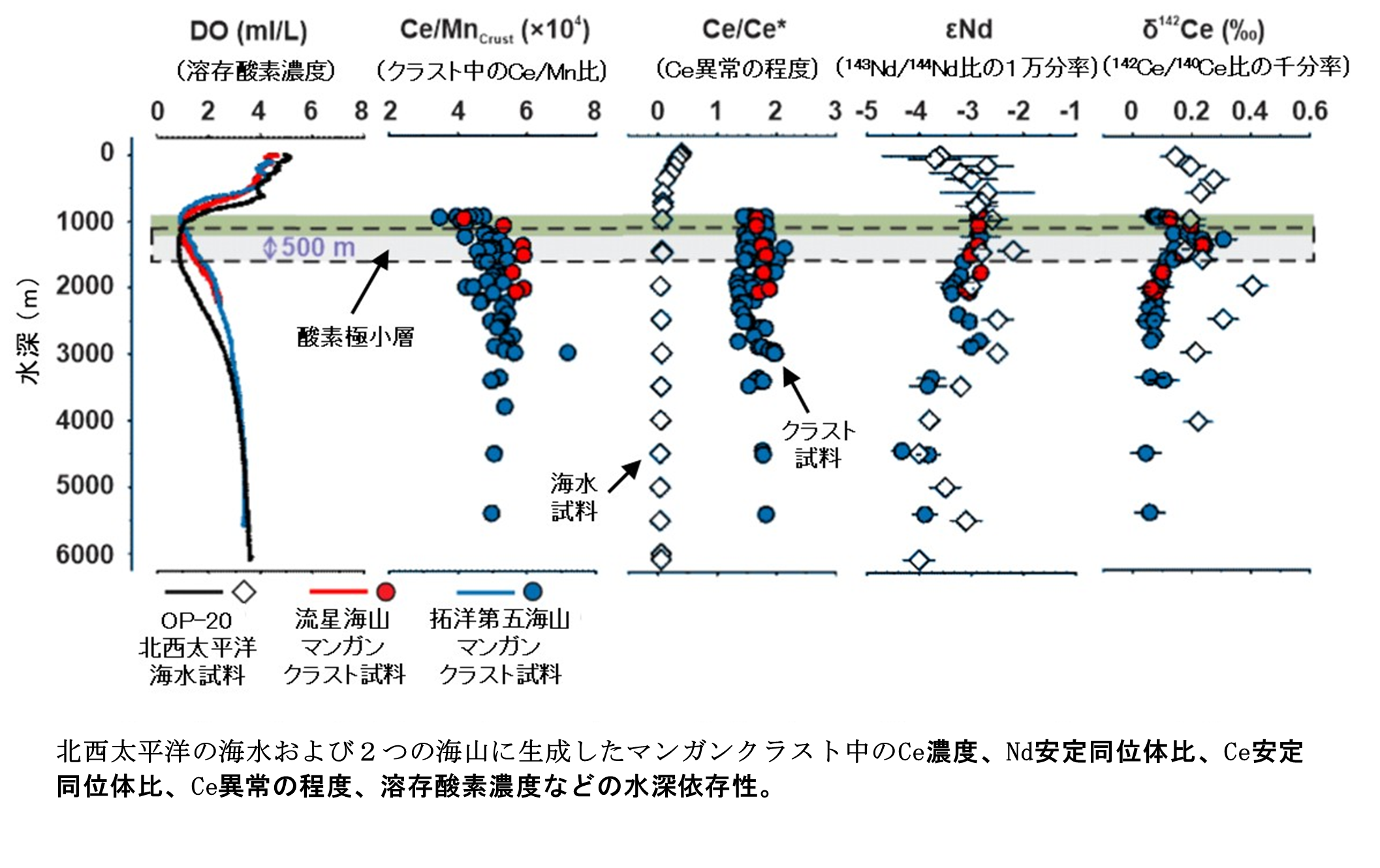
The interaction between a large, dissolved Mn reservoir in the oxygen minimum zone (OMZ) and the deeper oxygenated water allows for Mn oxidation and precipitation at their interface. The current paradigm posits that the OMZ acts as a Mn2+ source necessary for hydrogenetic ferromanganese encrustation, while the encrustation itself is not thought to occur within the OMZ, although this remains a subject of ongoing debate. Marine Fe-Mn crusts enrich critical metals including those with high affinity for Mn oxides (e.g., Ce), which provide insights into the fate of Mn. Here, we present the δ142Ce profiles in Fe-Mn crusts and surrounding seawater from the Northwest Pacific, demonstrating continuous growth of crusts from the OMZ to abyssal depths (5000 to 6000 meters). We identify heterogeneous δ142CeSW profiles in seawater and crusts across the OMZ in the Northwest Pacific Ocean, which are closely linked with the ocean Mn cycle. We further quantify a close association of Ce with Mn oxides in Fe-Mn crusts and Ce isotope fractionation between crusts and ambient seawater, bridging marine Mn and Ce cycles. These results support a revised model in which Mn oxide precipitation could initiate within the OMZ and persist into the deep ocean.