

2026-05-05 国立天文台
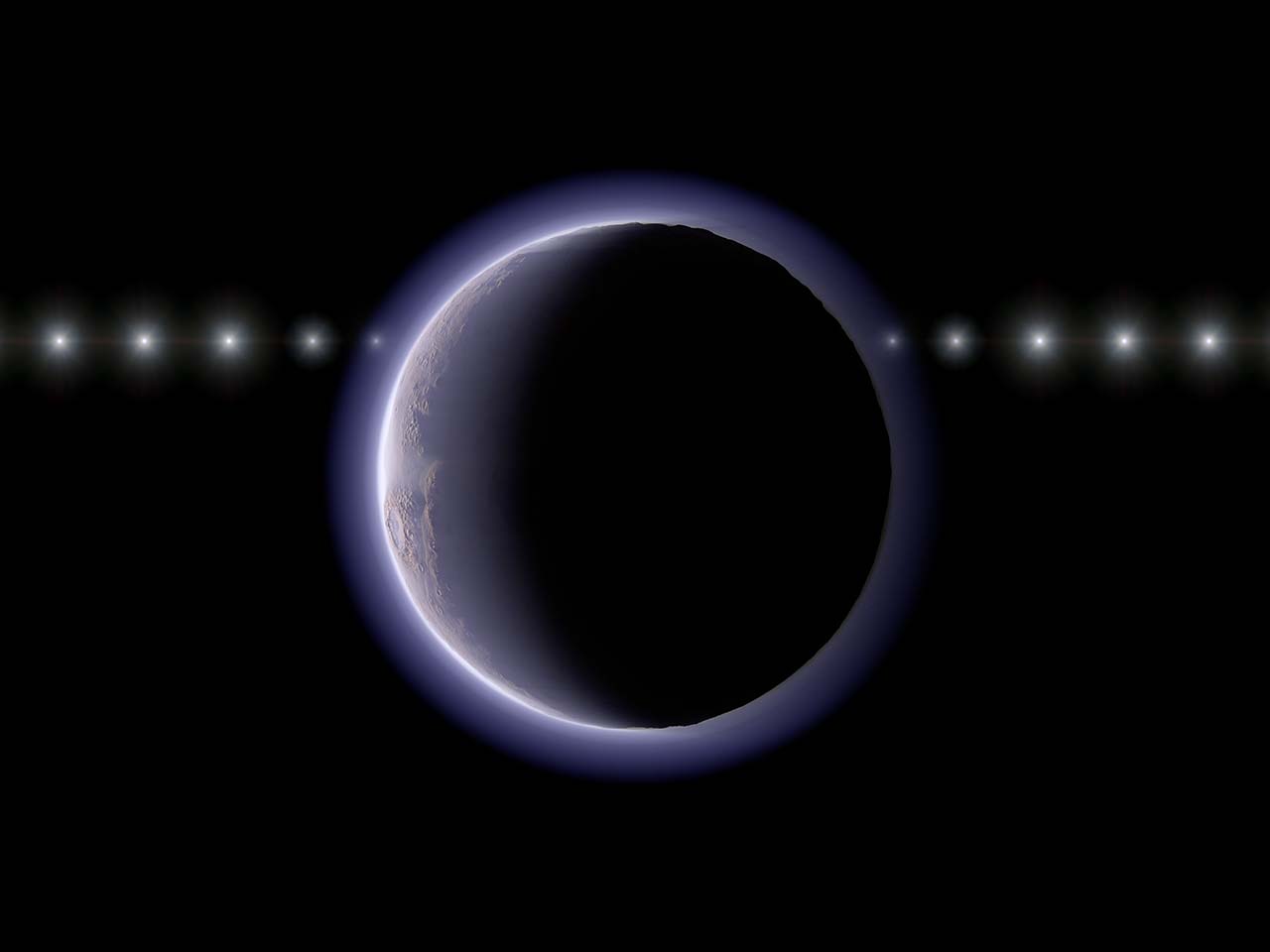
太陽系外縁天体2002 XV93が恒星を隠す様子。大気によって緩やかに暗くなっていった現象が捉えられた。(クレジット:国立天文台)
<関連情報>
- https://www.nao.ac.jp/news/science/2026/20260505-prc.html
- https://www.nature.com/articles/s41550-026-02846-1
冥王星以遠の太陽系外天体における大気の検出 Detection of an atmosphere on a trans-Neptunian object beyond Pluto
Ko Arimatsu,Fumi Yoshida,Tsutomu Hayamizu,Satoshi Takita,Katsumasa Hosoi,Takafumi Ootsubo &Jun-ichi Watanabe
Nature Astronomy Published:04 May 2026
DOI:https://doi.org/10.1038/s41550-026-02846-1
Abstract
The only trans-Neptunioan object (TNO) with a detected atmosphere so far is Pluto, which has an average surface pressure of 10 μbar. Investigations of other large (>500 km) TNOs have only been able to establish upper limits of 1–100 nbar. A recent near-infrared study reported methane gas emission from Makemake, although its origin remains uncertain. Here we report that a stellar occultation campaign performed on 10 January 2024 of the ~250-km-radius plutino (612533) 2002 XV93 reveals a refractive signature, indicating a thin atmosphere. We derive a surface pressure of 100–200 nbar, above the previous limits for other larger bodies. This discovery shows that even a few-hundred-kilometre TNO can host, at least transiently, an atmosphere, challenging standard volatile-retention scenarios. Our findings suggest that a fraction of distant icy minor planets can exhibit atmospheres, potentially sustained by ongoing cryovolcanic activity or produced by a recent impact of a small icy object.
